What is Shambhavi Mahamudra: The Honest Beginner Guide
You’ve heard it’s the most powerful meditation Isha Foundation teaches. But You’ve also heard you can’t just learn it from a video.
So you’re stuck. Interested, but with no straight answer about what this practice actually is, what it does, or how to start.
That’s a frustrating place to be. And it’s exactly why most people give up before they ever begin.
Here’s the truth: Shambhavi Mahamudra isn’t complicated. It’s just badly explained.
This guide fixes that. In the next few minutes you’ll learn:
- What is Shambhavi Mahamudra – in plain language, no Sanskrit required
- How it differs from Shambhavi Mudra – the mix-up that confuses almost everyone
- What science has measured in people who practice it
- How to actually begin – including why a YouTube tutorial won’t get you there
By the end, you’ll know exactly what this practice is, whether it’s right for you, and what your next step looks like.
Let’s clear this up.
For context on how Shambhavi compares to the other major kriya practice taught in India, read our detailed comparison of Shambhavi Mahamudra vs Sudarshan Kriya.
What is Shambhavi Mahamudra?
Shambhavi Mahamudra is a 21-minute yogic kriya that combines pranayama, mantra chanting, bandhas, and breath-watching in a specific sequence, transmitted by Sadhguru as part of the Inner Engineering program and practiced by millions of dedicated practitioners worldwide.
The name carries its meaning precisely. Shambhavi refers to Shambhavi – the goddess Parvati as the consort of Shiva, representing the energy of the highest consciousness. Maha means great. Mudra means seal you lock something in. Together the name points to a practice that seals the practitioner into an experience of the highest possible inner state.
According to Isha Foundation, Sadhguru describes Shambhavi Mahamudra not as a method but as a doorway.
The practice creates the conditions for grace not as a philosophical concept but as a force that transforms the system from within.
It unlocks perceptions and experiences that lie beyond ordinary mental activity. Millions of practitioners worldwide now practice this kriya daily.
The ancient textual basis is precise. Fitsri Yoga cites the Gherand Samhita, stanza 59: “Direct your eyes toward the middle of the eyebrows and meditate upon your own self.
It is Shambhavi Mudra, the most secret practice of all the Tantra scriptures.
What Sadhguru transmits as Shambhavi Mahamudra Kriya is a complete, structured elaboration of this ancient foundational gesture, embedded within a sequence of preparatory practices designed to make the meditator fully receptive before the mudra itself is entered.
What is the Difference Between Shambhavi Mudra and Shambhavi Mahamudra Kriya?
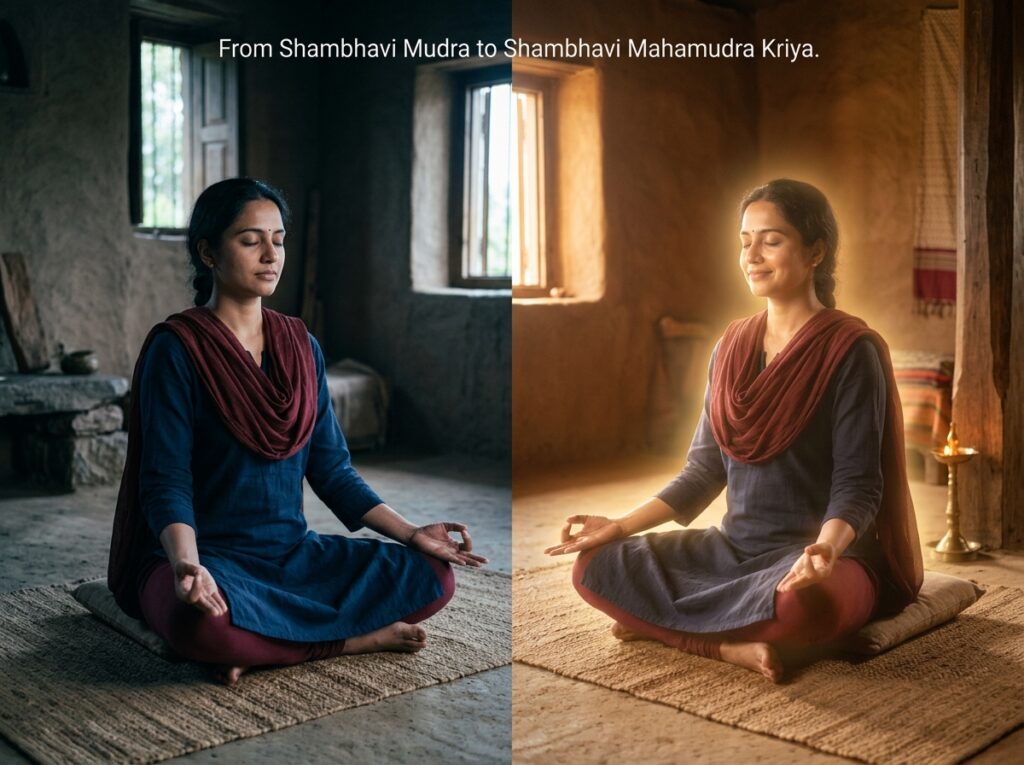
Shambhavi Mudra is the ancient standalone practice of directing the gaze to the eyebrow center in meditation.
Shambhavi Mahamudra Kriya is a complete 21-minute yogic sequence taught by Sadhguru that incorporates Shambhavi Mudra within a broader structure of preparatory asanas, pranayama, bandhas, mantra, and breath-watching.
This distinction confuses many beginners and the confusion matters practically. Searching for “how to practice Shambhavi Mahamudra” online returns a mixture of instructions for the simple mudra and descriptions of the complete kriya and they are not interchangeable.
According to Apollo247, which documents the classical practice, Shambhavi Mudra is a yoga technique in which you gently direct the gaze toward the space between the eyebrows while keeping the face soft and the breath steady.
The practice directs attention to the eyebrow centre, the region popular accounts equate with the pineal gland, though that equation is a twentieth-century overlay rather than anything the tradition states.
It is used within meditation to anchor attention, calm mental chatter, and support a meditative state. It is accessible, ancient, and can be practiced independently.
Shambhavi Mahamudra Kriya is a different structure entirely. Fitsri Yoga describes it as a unique 21-minute practice that incorporates several preparatory asanas called Upa Yoga, breathing exercises, bandhas, mudras, mantra chanting, and meditation in a specific sequence.
This kriya is developed by Sadhguru Jaggi Vasudev and taught exclusively through Isha Foundation’s Inner Engineering program.
It cannot be learned from reading an article or watching a video – it requires live transmission from an authorized Isha teacher and initiation by Sadhguru himself. Attempting to self-learn the complete kriya from a description is not only ineffective but actively cautioned against by the tradition.
The simple way to understand the difference: Shambhavi Mudra is a single technique.
Shambhavi Mahamudra Kriya is a complete practice system in which that technique is one integral component among several.
What Does Science Say About Shambhavi Mahamudra?
Direct Answer: Peer-reviewed research has documented that regular Shambhavi Mahamudra Kriya practice produces a 41 percent reduction in stress after six weeks, significantly higher cortisol awakening response, increased BDNF, improved gamma brainwave amplitude, and better heart rate variability.
These factors makes it one of the most scientifically studied yogic practices in the world.
The research base behind Shambhavi Mahamudra is unusually strong for a meditation technique. Most meditation studies use heterogeneous samples and poorly defined practices.
Shambhavi research benefits from a clearly defined, standardized 21-minute practice transmitted identically to all participants.
According to Isha Foundation’s Inner Engineering research page, a study of 6,892 participants conducted during the COVID-19 pandemic found that practitioners who practice Shambhavi Mahamudra daily had lower median stress levels lower anxiety and depression, and higher scores for joy and wellbeing.
Inner Engineering practitioners reported 31 percent lower stress scores than the general population. For daily practitioners, stress reduction reached 54 percent after eight weeks of practice.
After six weeks of practicing Shambhavi Mahamudra Kriya specifically, stress levels and negative emotions reduced by 41 percent and 50 percent respectively.
The most significant recent study is the BLISS trial at Beth Israel Deaconess Medical Center, a Harvard-affiliated hospital. According to ClinicalTrials.gov, this longitudinal study officially titled “Brain Health With Inner Engineering: Longitudinal Study of Shambhavi Mahamudra Kriya Meditation” began in January 2023 and completed in December 2025, with final data updated in May 2026.
This is the most rigorous institutional study of Shambhavi Mahamudra ever conducted, and its completion means peer-reviewed results are expected to follow within the next year.
What Are the Benefits of Practicing Shambhavi Mahamudra?
Documented benefits of Shambhavi Mahamudra Kriya include increased gamma brainwave amplitude, improved heart rate variability, higher cortisol awakening response, elevated BDNF levels, reduced stress and anxiety, deeper sleep, and a progressive shift from mental reactivity to inner stillness.
A 2020 study published in PMC from Indiana University School of Medicine found that Inner Engineering practices including Shambhavi Mahamudra were associated with increased endocannabinoids, improved mental health outcomes, and cannabimimetic effects.
This means that the body’s own naturally produced wellbeing compounds increased measurably in practitioners.
The same study documented increased gamma brainwave amplitude, heart rate variability, sympathovagal balance, BDNF, and cortisol awakening response in participants.
Stillchemy documents two particularly significant neurological markers. The cortisol awakening response – the rapid surge of cortisol in the first 30 to 45 minutes after waking, which governs alertness and immune activation is significantly higher in people who have practiced Shambhavi for at least 90 days with a morning practice.
The BDNF, or brain-derived neurotrophic factor, which supports neuroplasticity, the brain’s ability to form new connections and adapt to experience, rises measurably after one mandala of practice, which is 40 to 48 days. These are not marginal effects. BDNF elevation is associated with reduced risk of depression and enhanced cognitive function.
The experiential benefits reported consistently by practitioners align with the physiological data: clearer thinking, less emotional reactivity, reduced anxiety without sedation, and a gradual shift in one’s baseline inner state from restless to settled.
Sadhguru’s description of the practice as a doorway rather than a method points to this quality the benefits compound over time rather than plateau.
How Do You Learn Shambhavi Mahamudra?
Shambhavi Mahamudra Kriya can only be learned through Isha Foundation’s Inner Engineering program, which includes a live transmission from an authorized Isha teacher.
It cannot be self-taught from written instructions or video content and the tradition explicitly cautions against attempting to do so.
According to a peer-reviewed study published on ResearchGate, Shambhavi Mahamudra Kriya is a multicomponent breath-based yogic practice taught at the beginner level of the Isha tradition. Its structure includes pranayama, chanting, and breath-watching among other components, delivered in a specific sequence that must be learned in its integrity to be effective.
The study’s authors describe it specifically as a practice taught within a structured program not a technique that can be decontextualized from its transmission context.
Isha Foundation’s Inner Engineering research page confirms that the practice is offered through Inner Engineering in-person programs as a live transmission.
To learn Shambhavi Mahamudra, one must first complete the Inner Engineering Online course a seven-session program and then attend an in-person completion session where Sadhguru performs the Shambhavi initiation.
The Inner Engineering Online program is available globally. In-person completion events are held across India and in multiple international locations throughout the year.
This is not a gatekeeping arrangement it is a technical requirement. The practice involves specific physiological processes including bandhas and breath patterns that, if performed incorrectly, can cause discomfort or ineffectiveness.
A headache from incorrect eye tension is the most commonly reported consequence of improper practice, which is why even experienced yoga practitioners are advised to receive proper guidance before attempting the kriya.
If you are new to meditation and looking for a starting point before pursuing Shambhavi Mahamudra, read our guide on how to start a daily meditation practice.
Also, you can check out our latest article on Shambhavi Mahamudra vs Isha Kriya.
Finally, for breathwork practices you can begin immediately without any help, explore our piece on the 11-minute miracle breathwork.
Summary Table: Shambhavi Mahamudra at a Glance
| Question | Answer |
|---|---|
| What is Shambhavi Mahamudra | A 21-minute yogic kriya combining pranayama, bandhas, mantra, and breath-watching transmitted by Sadhguru |
| Ancient source | Gherand Samhita stanza 59 — “the most secret practice of all the Tantra scriptures” |
| How long is one session | 21 minutes |
| What does science confirm | 41% stress reduction after 6 weeks, increased BDNF, gamma brainwave amplitude, higher cortisol awakening response |
| Can I self-learn it | No, requires Inner Engineering program and live transmission from authorized Isha teacher |
| How is it different from Shambhavi Mudra | Shambhavi Mudra is a single technique. Shambhavi Mahamudra Kriya is a complete 21-minute practice system |
| Who practices it | Millions of practitioners worldwide across 300+ Isha centers |
Key Takeaways For Readers
What is Shambhavi Mahamudra?
Shambhavi Mahamudra is a 21-minute yogic kriya transmitted by Sadhguru through the Inner Engineering program. It combines pranayama, bandhas, mantra chanting, and breath-watching in a specific sequence, based on the ancient Shambhavi Mudra documented in the Gherand Samhita as the most secret practice of all Tantra scriptures. This is the opposite of Isha Kriya, which the same organisation distributes free with no course, no fee and no initiation.
What is the difference between Shambhavi Mudra and Shambhavi Mahamudra Kriya?
Shambhavi Mudra is a standalone ancient technique of directing the gaze to the eyebrow center in meditation. Shambhavi Mahamudra Kriya is a complete 21-minute practice system taught by Sadhguru that incorporates Shambhavi Mudra within preparatory asanas, pranayama, bandhas, and breath-watching. They are not interchangeable.
What are the scientifically proven benefits of Shambhavi Mahamudra?
Research documents a 41 percent reduction in stress after six weeks of practice, 31 percent lower stress scores than the general population, increased gamma brainwave amplitude, improved heart rate variability, higher BDNF levels, and elevated cortisol awakening response. A longitudinal study at Beth Israel Deaconess Medical Center completed in December 2025 is expected to add further findings.
Can I learn Shambhavi Mahamudra from YouTube or a book?
No. Shambhavi Mahamudra Kriya requires live transmission from an authorized Isha teacher and initiation through the Inner Engineering program. The tradition explicitly cautions against self-teaching due to the physiological precision required.
How long does it take to see benefits from Shambhavi Mahamudra?
Research shows stress reduction begins after six weeks of regular practice. BDNF elevation linked to neuroplasticity and reduced depression risk rises measurably after one mandala of 40 to 48 days. Cortisol awakening response improvements are documented after 90 days of daily morning practice.
References
- Isha Foundation. (2023). What Is Shambhavi Mahamudra. https://isha.sadhguru.org/en/wisdom/article/what-is-shambhavi-mahamudra
- Fitsri Yoga. (2025, June 5). Shambhavi Mudra and Shambhavi Mahamudra Kriya: Benefits and Steps. https://www.fitsri.com/yoga-mudras/shambhavi-mudra
- Apollo247. (2026). Shambhavi Mudra Steps, Benefits, and Meditation Guide. https://www.apollo247.com/health-topics/general-medical-consultation/steps-benefits-and-guide-for-shambhavi-mudra
- Inner Engineering Research. (2026). Scientific Research on Shambhavi Mahamudra Kriya. https://innerengineering.sadhguru.org/research
- ClinicalTrials.gov. (2026, May 14). Brain Health With Inner Engineering Meditation — BLISS Study. https://clinicaltrials.gov/study/NCT05455814
- PMC. (2020). Inner Engineering Practices and Advanced Isha Yoga Retreat Are Associated with Cannabimimetic Effects. https://pmc.ncbi.nlm.nih.gov/articles/PMC7293737/
- Stillchemy. (2025, November 8). 14 Health Benefits of Shambhavi Mahamudra Kriya by Isha Foundation. https://stillchemy.com/benefits-of-shambhavi-mahamudra/
- ResearchGate. (2026, April 30). Effects of Shambhavi Mahamudra Kriya on Perceived Stress and General Well-Being. https://www.researchgate.net/publication/319995257