Isha Kriya is Free but Does It Work?
Isha Kriya costs nothing. No course fee, no registration, no completion program, no initiation. Twelve minutes, a recording, and a floor.
That is unusual enough in this field to deserve scrutiny rather than enthusiasm. Free things are not automatically good, and the absence of a price tag is not evidence of anything.
Two published studies exist. One has open peer review attached, which means you can read what the reviewers actually thought.
This article covers what the practice involves, what the research found, what its own reviewers questioned, how long the tradition says it takes, and the question most people arrive with: whether free is enough or whether you eventually pay.
For the paid practice from the same organization, see our guide to what Shambhavi Mahamudra actually is.
What is Isha Kriya?
Isha Kriya is a twelve to eighteen minute guided meditation offered free by the Isha Foundation, combining breath awareness with a silent mental affirmation and seven sounded exhalations.
The name explains the intent. Isha’s official page states that Isha refers to the source of creation and kriya means internal action, making the stated purpose contact with the source of your own existence.
Sadhguru describes the effect as creating a space between you and your body, and between you and your mind, on the reasoning that suffering occurs at those two levels rather than at the level of what you actually are.
Take or leave the framing. The practice works identically either way.
One thing worth stating plainly, because most coverage omits it. Healthline’s guide to Isha Kriya runs to nearly a thousand words and never mentions the cost. There isn’t one.
Isha distributes the guided recording and written instructions at no charge, which distinguishes it sharply from Inner Engineering and Shambhavi Mahamudra, both of which are paid.
If you are new to sitting practice generally, our guide on how to start a daily meditation practice covers posture and consistency before you add a specific technique.
How Do You Practice Isha Kriya?
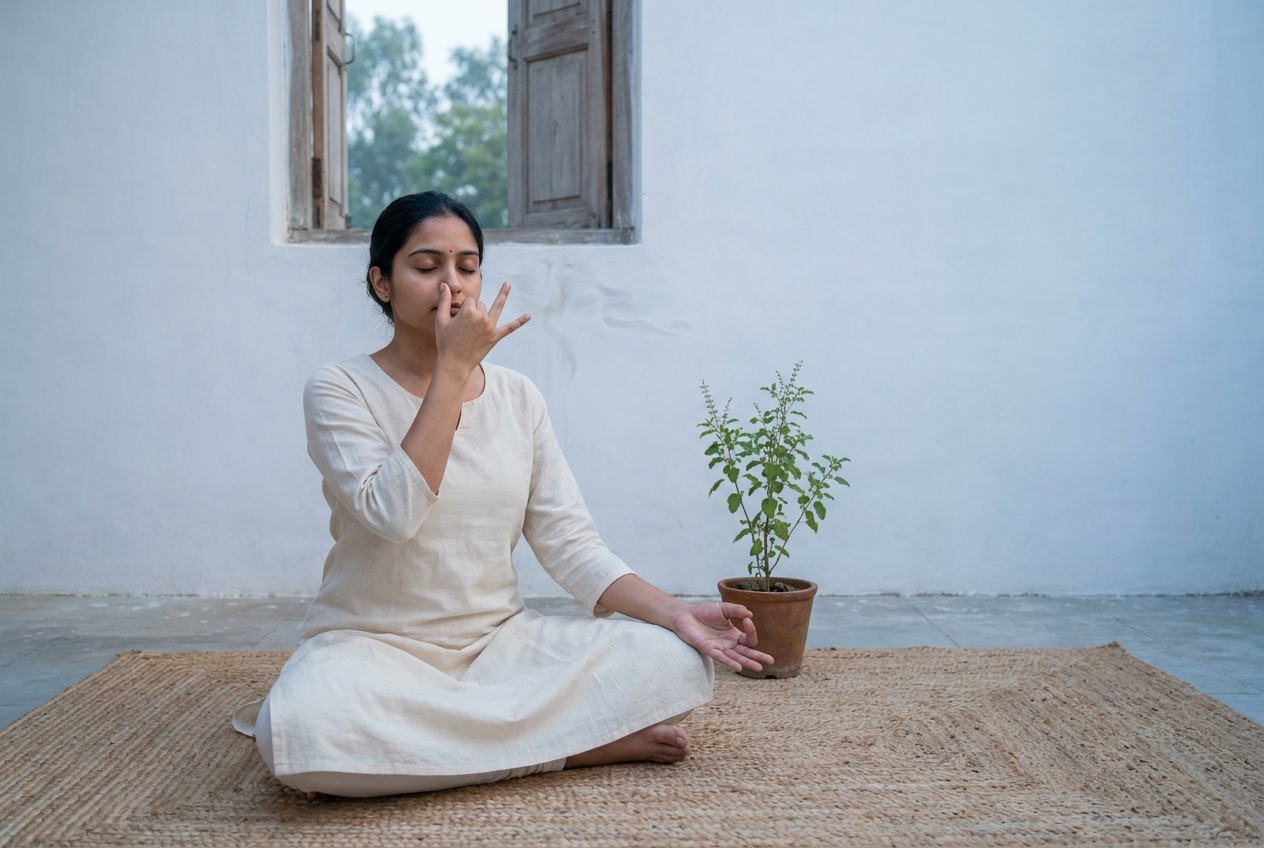
Sit with a straight spine, eyes closed, face tilted slightly upward and palms facing up. Breathe with two silent phrases for seven minutes, sound a long A on seven exhalations, then sit still for five minutes with attention between the eyebrows.
The official instructions set out three stages.
Stage one, roughly seven minutes. Breathe slowly and deeply. On the inhalation, mentally repeat “I am not the body.” On the exhalation, “I am not even the mind.” Think it rather than say it.
Stage two, seven repetitions. Exhale fully while sounding a long A. The sound originates just below the navel, not in the throat.
Stage three, roughly five minutes. Sit still with a light focus on the space between the eyebrows. Extend this to eleven minutes if you have time, which brings the full practice to eighteen.
Twelve minutes is the stated minimum for any single session.
Positivity.org adds a practical framing worth borrowing. Pick a specific time and hold it.
Morning practice tends to energise the day, evening practice releases accumulated tension, and whichever you can realistically commit to most days is the correct answer.
Three constraints from the official guidance are easy to miss. Do not break in the middle once you have started.
A chair is fine if sitting cross-legged is difficult, with ankles crossed right over left. And Isha advises against practising around midnight specifically, without offering much reasoning.
What Does the Research on Isha Kriya Actually Show?
Two published studies. A single fifteen-minute session significantly reduced mood disturbance in over three hundred operating room staff, and a six-week online program reduced self-reported depression and anxiety within two weeks.
The larger study is Rangasamy and colleagues, published in F1000Research and archived at PMC.
Researchers surveyed perioperative healthcare providers using the Perceived Stress Scale.
They then ran a fifteen-minute guided Isha Kriya session at surgical grand rounds and at an international anesthesia conference.
Mood was measured before and after using the Profile of Mood States questionnaire.
Baseline stress differed by role. Surgeons and anaesthesiologists recorded a median Perceived Stress Score of 17 against 14 for nurses, significant at P equals 0.01.
After a single session, total mood disturbance fell significantly across both cohorts, with anger showing the largest reduction.
That is a real finding from one sitting, in a population under genuine occupational stress rather than a convenience sample of wellness enthusiasts.
The second study, published in Frontiers in Psychiatry, followed a six-week online program and reported reductions in self-reported anxiety and depression within two weeks of daily practice, sustained through the remainder of the program.
Two studies, both positive. Now the part that does not appear anywhere else.
What the Research Does Not Show?
The operating room study was a pilot with no control group. Its own peer reviewers publicly questioned a discrepancy in the participant numbers.
Neither study compares Isha Kriya against any alternative.
F1000Research publishes reviewer comments openly alongside the paper. That is unusual and genuinely useful. On the article page, a reviewer raises a direct question. 362 participants completed the stress questionnaire.
Data is reported for 313. The reviewer asks who the remaining 49 were and why they were excluded.
The same reviewer notes that participant counts in the results table do not reconcile with the numbers stated in the text.
This does not invalidate the study. Pilot work is exploratory by design. Open review exists precisely so these questions get asked in public rather than buried.
But it is context every summary of this research has left out, including Healthline’s.
The design limitation matters more than the arithmetic. This was a prospective interventional pilot with no control condition.
Participants sat quietly for fifteen minutes during a working day and reported feeling better afterward. Some of that is the practice. Some of it may simply be the fifteen minutes.
The study’s senior author later wrote about it in Psychology Today. He frames the finding carefully, noting that even a short session appears to provide immediate psychological benefit.
That is the correct level of confidence.
What is genuinely absent is comparison. No study places Isha Kriya beside a different free technique, a paid program, or simply resting with your eyes closed.
We know it does something. We do not know how much of that is specific to this technique.
How Long Before Isha Kriya Works?
The tradition prescribes twice daily for 48 days, described as one mandala. Or once daily for 90 days.
Research shows measurable mood change from a single session, with sustained effects around two weeks.
There is a specific protocol here, and it is easy to miss.
Healthline’s guide answers the question “how many days should you do Isha Kriya meditation” without giving a number of days, suggesting instead that you start twice weekly and build toward daily practice.
Isha’s own instructions are more specific.
Isha’s instructions set the commitment explicitly. Twelve to eighteen minutes minimum per session.
Twice daily for 48 days, which constitutes one mandala or full cycle. Or once daily for 90 days.
Isha’s research summary frames the practice as requiring nothing beyond the time itself. It can be done in any setting.
Isha’s guidance also permits up to three to five sessions daily. At least four hours must separate each one.
So the honest answer sits at two ends. Something measurable happens immediately, as the operating room study demonstrated.
The tradition’s claim concerns what accumulates across six to twelve weeks. No published study has tested that specific protocol.
A practical middle path: commit to 40 days, then assess. Long enough for the practice to settle into a routine. Short enough that it does not feel permanent.
Isha Kriya Side Effects: Is It Safe?
For most people, Isha Kriya is safe.
No side effects have been studied for Isha Kriya specifically, but across meditation practices roughly 8.3 percent of participants report adverse effects, most commonly anxiety, depression and cognitive changes.
Pre-existing mental health conditions were the strongest predictor.
Meditation is not risk-free simply because it is drug-free. The honest figure is available.
A systematic review in Acta Psychiatrica Scandinavica examined 83 studies covering 6,703 participants.
Overall adverse event prevalence was 8.3 percent. The researchers describe that rate as comparable to psychotherapy in general.
The most commonly reported effects were anxiety, depression and cognitive anomalies.
That review covers meditation broadly, not Isha Kriya specifically. No adverse event data exists for this technique in isolation. That gap is itself worth knowing.
Practically, people with a history of trauma or dissociative episodes may find any inward-turning practice destabilizing without support.
If that describes you, practice with someone available rather than alone. Consider a grounding activity afterward.
If you experience persistent distress during or after practice, stop and speak to a qualified professional.
For a fuller treatment of breathwork safety and who should seek medical clearance first, read our piece on Sudarshan Kriya side effects.
Is Isha Kriya Enough or Do You Need to Pay?
For stress, sleep and general emotional regulation, the free practice is a defensible starting point. It may be sufficient.
The paid programs teach a different practice with structured transmission and a fixed routine.
This is the question most readers arrive with. No ranking article addresses it.
Three honest points.
The evidence base is thinner here than for the paid practice. Isha Kriya has two studies. Shambhavi Mahamudra, taught through Inner Engineering, has considerably more. That includes one-year follow-up data and work approved at a Harvard-affiliated hospital. If published research is your criterion, the paid route is better supported. Whether that reflects the practices themselves or simply reflects where research funding flows is a fair question.
What money buys is structure, not demonstrably better outcomes. Nobody has run the comparison. The paid programs add a fixed sequence, live transmission, and a routine that removes the daily decision. People who have repeatedly abandoned self-directed practice often need exactly that scaffolding. People who already practice consistently may be paying for something they have.
Starting free costs you nothing but time. Forty days of Isha Kriya either works for you or it does not. Either outcome is useful. And it is information you cannot buy.
For the full assessment of the paid route, read our analysis of whether Inner Engineering is worth it.
For a comparison of the two major paid kriya programs taught in India, see Sudarshan Kriya versus Shambhavi Mahamudra.
Summary Table For Isha Kriya
| Question | Answer |
|---|---|
| Cost | Free. No course, fee or initiation. |
| Duration | 12 to 18 minutes per session, 12 minimum |
| Structure | Three stages: silent affirmation with breath, seven sounded exhalations, stillness at the eyebrow center |
| Prescribed protocol | Twice daily for 48 days, or once daily for 90 days |
| Maximum frequency | Up to 3 to 5 times daily, 4 hours between sessions |
| Research base | Two published studies |
| Strongest finding | Reduced mood disturbance after one 15-minute session, 313 operating room staff |
| Main limitation | Pilot design, no control group, participant discrepancy in open peer review |
| Comparison data | None against any alternative, free or paid |
| Adverse events | 8.3 percent across meditation broadly, no technique-specific data |
FAQs on Isha Kriya
Is Isha Kriya really free?
Yes. Isha Kriya requires no course fee, no registration and no initiation. The guided recording and written instructions are distributed at no cost by the Isha Foundation. This separates it from Inner Engineering and Shambhavi Mahamudra, both of which are paid.
How long does Isha Kriya take?
Twelve to eighteen minutes per session. Twelve minutes is the stated minimum. The prescribed commitment is twice daily for 48 days, described as one mandala, or once daily for 90 days. Isha permits up to five sessions daily with four hours between them.
Does Isha Kriya actually work?
Two published studies report positive results. A single 15-minute session significantly reduced mood disturbance in operating room professionals. A six-week online program reduced self-reported depression and anxiety within two weeks. Both have limitations. The pilot study had no control group, and no research compares Isha Kriya against any alternative.
Is Isha Kriya enough or do I need Inner Engineering?
For stress, sleep and emotional regulation, the free practice is a defensible starting point and may be sufficient. The paid programs teach a different practice with structured transmission and a fixed routine. No research compares them directly. Forty days of Isha Kriya costs nothing and tells you what you actually need.
Key Takeaways for Readers With References
- Isha Kriya requires no fee, no course and no initiation. It runs 12 to 18 minutes across three stages. (Source: Isha Foundation https://isha.sadhguru.org/global/en/yoga-meditation/yoga-program-for-beginners/isha-kriya-meditation)
- A single 15-minute session significantly reduced mood disturbance among operating room professionals. Anger was most affected. Surgeons and anesthesiologists recorded a median Perceived Stress Score of 17 against 14 for nurses. (Source: F1000Research via PMC https://www.ncbi.nlm.nih.gov/pmc/articles/PMC7327726/)
- That study was a pilot with no control group. Its peer reviewers publicly asked why data was reported for 313 of 362 participants. (Source: F1000Research https://f1000research.com/articles/8-335/v1)
- A six-week online program reported reduced self-reported depression and anxiety within two weeks. (Source: Frontiers in Psychiatry https://www.frontiersin.org/journals/psychiatry/articles/10.3389/fpsyt.2022.944973/full)
- The prescribed commitment is twice daily for 48 days or once daily for 90 days. Several widely-read guides state incorrectly that no protocol exists. (Source: Inner Engineering https://innerengineering.sadhguru.org/online/blog/remarkable-research-findings-on-isha-kriya-meditation)
- Adverse events occur in roughly 8.3 percent of meditation participants overall. Pre-existing conditions are the strongest predictor. (Source: Acta Psychiatrica Scandinavica https://doi.org/10.1111/acps.13225)
References
- Isha Foundation. Isha Kriya: Free Online Guided Meditation. https://isha.sadhguru.org/global/en/yoga-meditation/yoga-program-for-beginners/isha-kriya-meditation
- Healthline. Your Guide to Isha Kriya Meditation Benefits and Practices. https://www.healthline.com/health/mental-health/isha-kriya-meditation
- Isha Foundation. Isha Kriya Instructions, English. https://www.slideshare.net/slideshow/isha-kriyainstructionsenglish/40165050
- Positivity.org. Isha Kriya. https://positivity.org/meditation/isha-kriya
- Rangasamy V, Susheel AT, Mueller A, Chang TFH, Sadhasivam S, Subramaniam B. The effect of a one-time 15-minute guided meditation (Isha Kriya) on stress and mood disturbances among operating room professionals: a prospective interventional pilot study. F1000Research. 2019;8:335. https://www.ncbi.nlm.nih.gov/pmc/articles/PMC7327726/
- F1000Research. Article 8-335, including open peer review. https://f1000research.com/articles/8-335/v1
- Frontiers in Psychiatry. Online guided meditation training improves self-reported symptoms of anxiety and depression within 2 weeks of practice. 2022;13:944973. https://www.frontiersin.org/journals/psychiatry/articles/10.3389/fpsyt.2022.944973/full
- Psychology Today. Could Meditation Be the Antidote to the Brain Rot Era? February 2025. https://www.psychologytoday.com/gb/blog/a-subtle-impact/202502/could-meditation-be-the-antidote-to-the-brain-rot-era
- Farias M, Maraldi E, Wallenkampf KC, Lucchetti G. Adverse events in meditation practices and meditation-based therapies: a systematic review. Acta Psychiatrica Scandinavica. 2020. https://doi.org/10.1111/acps.13225
- Inner Engineering. Remarkable Research Findings on Isha Kriya Meditation. https://innerengineering.sadhguru.org/online/blog/remarkable-research-findings-on-isha-kriya-meditation