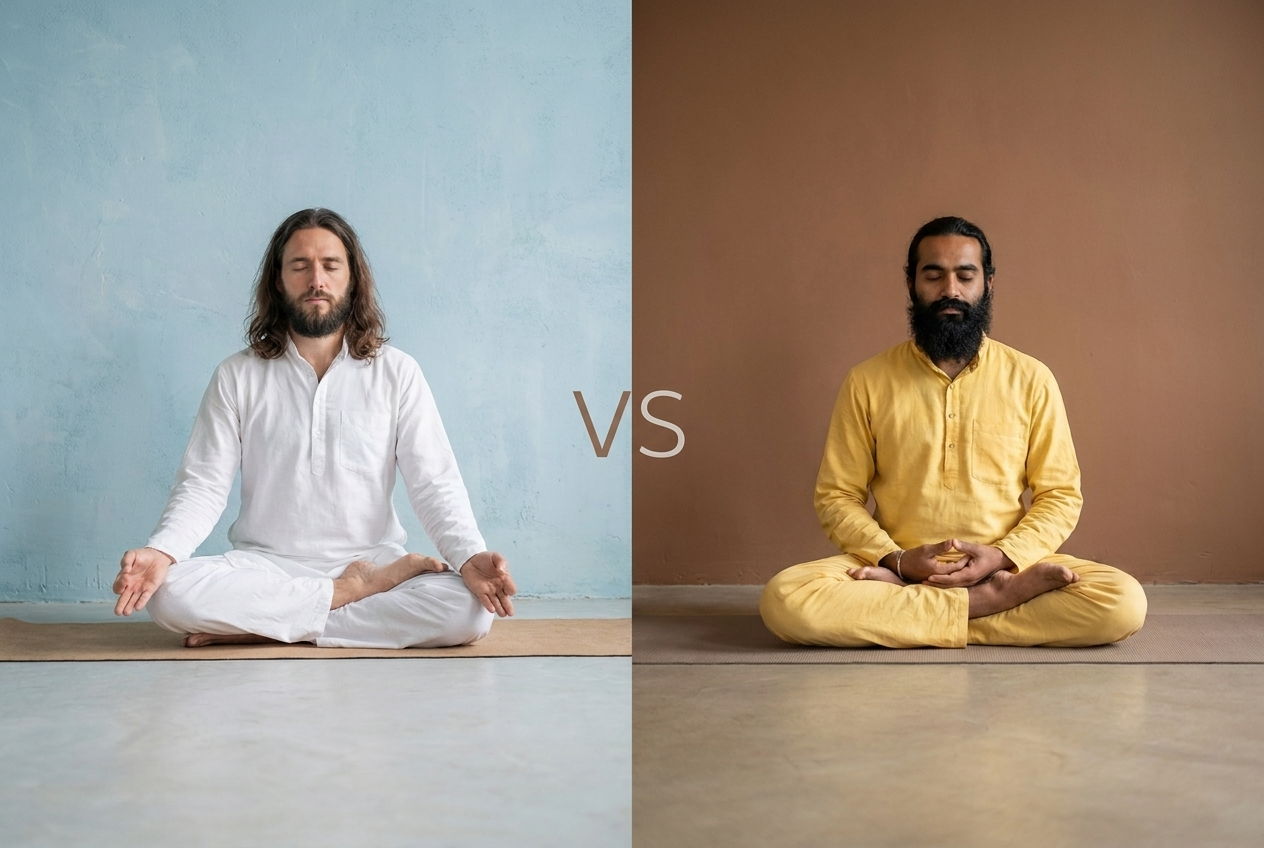
Sudarshan Kriya vs. Shambhavi Mahamudra
Sudarshan Kriya and Shambhavi Mahamudra are two of the most widely practiced yogic techniques today, taught by Sri Sri Ravi Shankar and Sadhguru respectively. Both aim to improve mental clarity, emotional balance, and inner wellbeing.
However, they differ in structure, approach, and depth. This Sudarshan Kriya vs. Shambhavi Mahamudra guide compares both practices to help you understand which may align better with your personal and spiritual goals.
Sudarshan Kriya vs Shambhavi Mahamudra: At a Glance Comparison
What are Sudarshan Kriya and Shambhavi Mahamudra?
Sudarshan Kriya is a rhythmic breathing technique designed to harmonize emotional and physiological states, while Shambhavi Mahamudra is a structured yogic kriya that combines breath, awareness, and meditation to balance inner energies.
Both use breath as a tool, but their intent differs, Sudarshan Kriya focuses more on cleansing emotional patterns, whereas Shambhavi focuses on inner stillness and alignment.
If you want the full picture on Shambhavi before comparing it to anything else, we have covered the technique in depth separately, including its textual basis in the Gherand Samhita, the Harvard affiliated BLISS trial, and why it cannot be self taught.
Who created Sudarshan Kriya and Shambhavi Mahamudra?
Sudarshan Kriya was developed by Sri Sri Ravi Shankar, founder of the Art of Living Foundation, and is taught globally through guided programs.
Shambhavi Mahamudra was designed by Sadhguru and is taught as part of the Inner Engineering program.
Both techniques originate from yogic traditions but reflect different teaching styles:
- Sri Sri → Breath-led emotional wellness
- Sadhguru → Energy-based transformation
How long does each practice take daily?
Sudarshan Kriya typically takes 20–30 minutes daily, while Shambhavi Mahamudra requires approximately 21 minutes.
Sudarshan Kriya duration varies depending on practice level and format. In contrast, Shambhavi Mahamudra follows a fixed 21-minute structure, including preparatory and meditative stages.
This makes:
- Sudarshan → Flexible
- Shambhavi → Structured and disciplined
What is the scientific research behind each technique?
Sudarshan Kriya has stronger clinical backing, while Shambhavi Mahamudra has growing research interest.
Sudarshan Kriya Research
Research shows rhythmic breathing techniques can:
- Improve emotional regulation
- Reduce stress and anxiety
- Enhance nervous system balance
Shambhavi Mahamudra Research
Initial observations suggest:
- Improved clarity and focus
- Better stress management
- Enhanced wellbeing
Additionally, broader breathwork research supports the role of controlled breathing in mental health improvement.
How do the breathing techniques differ?
Sudarshan Kriya uses rhythmic breathing cycles, while Shambhavi Mahamudra integrates breath with stillness and awareness.
Sudarshan Kriya
- Cyclical breathing patterns
- Dynamic rhythm
- Emotional release mechanism
Shambhavi Mahamudra
- Controlled breath awareness
- Stillness-focused
- Energy alignment
Sudarshan Kriya vs. Shambhavi Mahamudra – which is better for beginners?
Sudarshan Kriya is generally easier for beginners, while Shambhavi Mahamudra requires consistency and discipline.
- Sudarshan Kriya:
1. Easier entry point
2. Quick emotional relief - Shambhavi Mahamudra:
1. Structured learning
2. Deeper long-term transformation
Choosing between the two is not only a question of which suits your temperament. Both are intensive practices with documented contraindications, and the research on adverse effects is rarely discussed in either organisation’s material.
We have covered what the peer reviewed literature actually documents in Sudarshan Kriya side effects, including who should seek medical clearance before starting either practice.
What are the costs and commitments for learning each?
Both techniques require guided programs for proper learning.
Sudarshan Kriya
- Conducted via Art of Living courses
- Short duration (few days)
Shambhavi Mahamudra
- Part of Inner Engineering
- Includes structured training
Can I practice both Sudarshan Kriya and Shambhavi Mahamudra?
Yes, but cautiously.
Both practices influence the system differently. Combining them without guidance may reduce effectiveness.
👉 Best approach:
- Start with one
- Build consistency
- Add the second later (if needed)
What do practitioners report feeling during each practice?
- Sudarshan Kriya: Emotional lightness, relaxation
- Shambhavi Mahamudra: Stillness, clarity, inner balance
Which practice is better for stress, anxiety, and sleep?
Sudarshan Kriya is highly effective for stress relief, while Shambhavi Mahamudra supports deeper long-term balance and stability.
Research in breath-based practices confirms improved emotional regulation and reduced stress response.
Can I learn Sudarshan Kriya or Shambhavi Mahamudra online?
- Sudarshan Kriya → Mostly guided courses
- Shambhavi Mahamudra → Available via online Inner Engineering
Yogic Culture Connection
In yogic science, breath is seen as the bridge between body and mind.
Both practices emerge from this understanding:
- Sudarshan Kriya uses breath to influence emotional patterns
- Shambhavi Mahamudra uses breath to align deeper energy systems
Ancient yogic texts describe breath as a tool to control prana (life energy), which governs mental and physical states.
This explains why both techniques, though different, aim at the same goal — inner transformation.
Practical Takeaways From Sudarshan Kriya vs. Shambhavi Mahamudra
To choose between the two:
✔ Choose Sudarshan Kriya if you want:
- Stress relief
- Emotional cleansing
- Immediate results
✔ Choose Shambhavi Mahamudra if you want:
- Deep inner stability
- Structured spiritual growth
- Long-term transformation
👉 Beginners should start with one practice and remain consistent before exploring others.
Practitioners of both techniques sometimes report experiences that go beyond stress relief, including energetic sensations along the spine and unexpected emotional release.
Whether that is Kundalini activation or simply the nervous system responding to intensive practice is contested. We have documented what practitioners report and what the research says in Kundalini awakening signs.
We applied the same test to something people spend considerably more on. What the rudraksha research actually studied turned out to be extracts rather than anything worn.
Summary: Key differences at a glance
- Sudarshan Kriya = Breath-driven emotional cleansing
- Shambhavi Mahamudra = Energy-based meditative kriya
- Sudarshan = Flexible + research-backed
- Shambhavi = Structured + deeper yogic process
Final Verdict on Sudarshan Kriya vs. Shambhavi Mahamudra
Both Sudarshan Kriya and Shambhavi Mahamudra are powerful tools rooted in yogic science. The choice depends on your intention.
If your focus is stress relief and emotional wellbeing, Sudarshan Kriya may be ideal. On the other hand, if you are looking for deeper spiritual growth and discipline, Shambhavi Mahamudra offers a structured path. You can also read our guide on:
1. What is Shambhavi Mahamudra
2. Shambhavi Mahamudra vs Isha Kriya
Ultimately, transformation depends not on the technique alone but on your consistency and commitment.
🔑 Key References
- Art of Living Foundation. Sudarshan Kriya Overview
https://www.artofliving.org/in-en/sudarshan-kriya - Isha Foundation. Inner Engineering Program
https://isha.sadhguru.org/in/en/inner-engineering - International Journal of Yoga. Yogic Breathing and Stress Reduction
https://www.ijoy.org.in/article.asp?issn=0973-6131;year=2012;volume=5;issue=1;spage=3;epage=8;aulast=Brown - Frontiers in Human Neuroscience. Breathing and Mental Health
https://www.frontiersin.org/articles/10.3389/fnhum.2018.00353/full - ScienceDirect. Breathing Techniques and Emotional Regulation
https://www.sciencedirect.com/science/article/pii/S0272735817300663 - Yoga Journal. Breathwork and Meditation Benefits
https://www.yogajournal.com/meditation/breathwork-benefits/ - Isha Foundation Blog. Shambhavi Mahamudra Insights
https://isha.sadhguru.org/in/en/blog/article/shambhavi-mahamudra


6 Comments