Karva Chauth 2026: Rs 28,000 Crore and a Surprising Survey
Karva Chauth 2026 falls on Thursday, October 29. The fast starts at sunrise, 6:40 AM, and breaks at moonrise, around 8:39 PM. Puja muhurat is 6:06 PM to 7:21 PM. Those are the timings every site will tell you.
What they will not tell you is this: Karva Chauth is now a Rs 28,000 crore economic event. And when someone actually asked 7,533 women why they keep the fast, the answer surprised everyone including the people running the survey.

The Rs 28,000 Crore Fast Nobody Is Talking About
The Confederation of All India Traders estimated that Karva Chauth 2025 generated Rs 28,000 crore in business nationwide. Delhi alone contributed Rs 8,000 crore of that. In 2024 it was Rs 22,000 crore. In 2023, Rs 15,000 crore.
That is 87% growth in two years.
The spending is not in one category. Sarees, lehengas, jewellery, earthen pots, mehndi services, beauty parlours, pooja thalis, gift sets, and silver Karvas are all part of it.
Markets like Chandni Chowk, Karol Bagh, and Sadar Bazar report long queues in the days before the festival.
The trade body said more than 85% of goods sold are locally made, which means the Karva Chauth economy is also a significant employer of Indian artisans.
Compare that to the narrative you usually see: Karva Chauth as either a religious ritual or a patriarchal tradition. The economic picture adds a third dimension that most coverage misses entirely.
Why Women Actually Keep the Fast (The Data Is Different From What You Think)
Shaadi.com surveyed 7,533 Indians, 58% women and 42% men, aged 21 to 50. The question was direct: why do you fast on Karva Chauth?
The answers broke down like this:
67% of women said they fast as an expression of love.
25% said tradition.
Only 8% said societal pressure.
Now look at what men thought their wives’ reason was. 55% of men assumed their partner fasts out of tradition. Only 32% thought love was the reason.
Men are wrong about why their wives fast. By a wide margin.
The reciprocation data is even more interesting. 75% of women said they would want their husband to fast with them. And 92% of men said they would want to do it.
But when it came to what reciprocation should look like, men and women diverged sharply. 76% of women said fasting together. 62% of men said taking the day off to spend quality time together.
Men want to show up in person. Women want to share the experience. That gap is worth understanding if you are in a marriage where Karva Chauth creates friction.
“I grew up thinking that this was an outdated and misogynistic tradition. But it is not really about fasting for someone else. Karwa Chauth celebrates womanhood and the strength each woman holds.”— Renuka, UC Berkeley graduate, writing for Kulfi Beauty — kulfibeauty.com, 2020
What Actually Happens During the Fast
Before sunrise, the mother-in-law gives sargi: fruits, sweets, mathri, and water, eaten before 6:40 AM when the fast begins. Nothing after that, including water, until the moon is sighted.
The evening ritual has a specific sequence. Women gather, a diya is lit in the karva (earthen pot), and the Vrat Katha is heard. Three stories are told traditionally: Veeravati, who broke her fast too early and paid for it; Karva, who saved her husband from a crocodile through her devotion; and Draupadi, whose fast sustained the Pandavas in the forest.
At moonrise, the woman looks at the moon through a chalni (sieve), then looks at her husband through the same sieve. He offers water, and she takes the first sip.
The chalni detail is often reduced to a romantic image for social media. But in Hindu ritual symbolism, a sieve separates the visible from the real.
You are not looking at your husband directly. You are looking through something that filters appearance from essence. The spiritual reading of this moment is richer than the photograph of it.
The Fasting, Meditation, and Mental Clarity Connection
A 16 to 24 hour fast with no water is a severe metabolic event.
Research on intermittent fasting, including a 2019 review published in Cell Metabolism, shows measurable effects: improved insulin sensitivity, reduced inflammatory markers, and the activation of autophagy, the cellular repair process the body triggers when it is not digesting food.

There is a second layer that most health content skips entirely. Digestion is one of the most energy-intensive processes the body runs.
On a fast day, that energy does not disappear. According to neuroscientist Dr. Mark Mattson’s research on fasting and the brain, reduced caloric intake increases levels of brain-derived neurotrophic factor (BDNF), a protein that supports neuron health, focus, and memory consolidation.
This is exactly why every serious meditation tradition, from Ananda Marga to Vipassana to Sufi practices, uses fasting as preparation for deep practice.
The Sanskrit term for this is upavasa, which literally means “dwelling near” the Divine. The ancient logic is physiological, even if it was never described that way: a body not processing food is a body with more attentional capacity available.
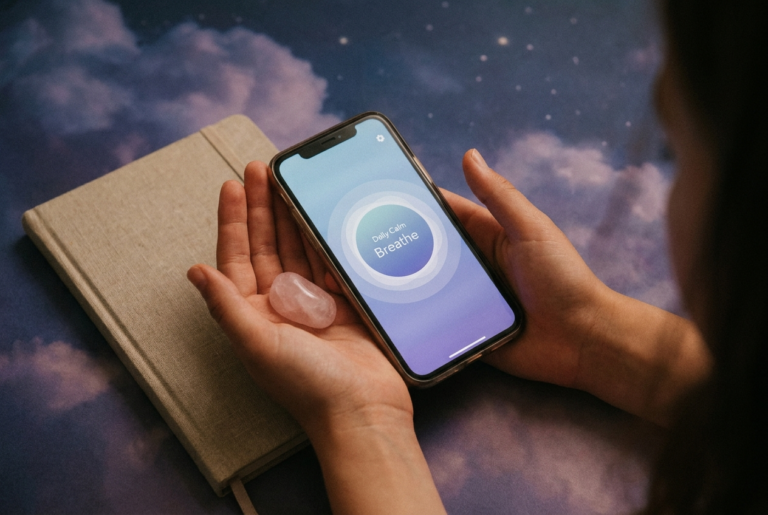
If you want to try something different this Karva Chauth, use the afternoon window after sargi has metabolised and before the puja begins for 20 minutes of breath-focused meditation.
The fast will likely make it easier than usual to sit still.
That is not coincidence. It is the same mechanism that every serious contemplative tradition has quietly relied on for centuries.
“Mentally they should live near their Lord. A fast day is an excellent time for sadhana.”— Shrii Shrii Anandamurti Ji, founder of Ananda Marga, on the purpose of upavasa — india.anandamarga.org/article-category/fasting
What the science does not support is the traditional claim that a wife’s fast extends her husband’s life. That is devotional logic.
It does not need a biological mechanism to have emotional meaning. But the clarity that comes from a full day without food is real, measurable, and the reason Karva Chauth has always been more than a love ritual.
Also read: Are you meditating correctly?
Karva Chauth 2026: Key Timings
Fast begins: 6:40 AM (sunrise, October 29)
Puja muhurat: 6:06 PM to 7:21 PM
Moonrise: Approximately 8:39 PM
Fast breaks: After sighting the moon and completing the ritual
City-specific moonrise times vary by 10 to 20 minutes. Check a local panchang if you are outside North India.
FAQs About Karva Chauth 2026
What is the date of Karva Chauth 2026?
Karva Chauth 2026 is Thursday, October 29. The fast runs from 6:40 AM to moonrise at approximately 8:39 PM.
What is the Karva Chauth muhurat for 2026?
Puja muhurat is 6:06 PM to 7:21 PM on October 29, 2026.
Why do women keep Karva Chauth fast?
According to a Shaadi.com survey of 7,533 respondents, 67% of women said they fast as an expression of love, 25% cited tradition, and 8% said societal pressure. The love motivation was the dominant one by a large margin.
Can husbands fast on Karva Chauth?
92% of men surveyed said they would want to reciprocate the fast. There is no scriptural prohibition. More couples are now observing the vrat together, especially in urban households.
What is the economic value of Karva Chauth?
CAIT estimated Rs 28,000 crore in nationwide business generated by Karva Chauth 2025, with Rs 8,000 crore in Delhi alone. This grew from Rs 15,000 crore in 2023.
REFERENCES USED:
- Karwa Chauth: Survey says women fast for love, not tradition — National Herald India, 2018
- Karva Chauth 2025: Rs 28,000 crore business — CAIT official press release
- Karva Chauth spurs Rs 28,000 crore nationwide — Tribune India, 2025
- How I’m Reimagining Karwa Chauth This Year — Kulfi Beauty (Renuka)
- Effects of Intermittent Fasting on Health, Aging, and Disease — de Cabo & Mattson, Cell Metabolism, 2019
- Fasting and BDNF: Mark Mattson’s research — FoundMyFitness
- The Synergy of Fasting and Meditation — Ananda Marga India