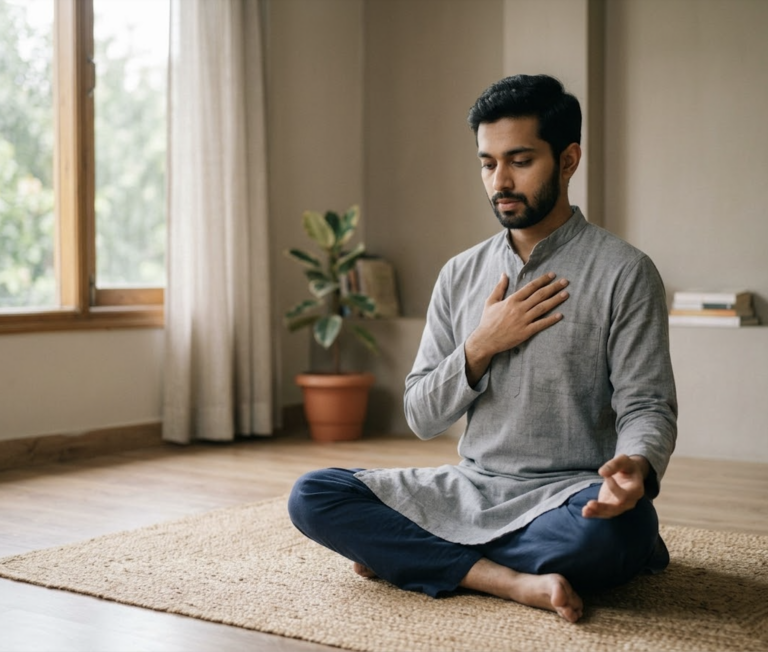
Does Yoga Nidra Helps to Sleep?
Yoga nidra for sleep makes an unusual promise. Lie down, stay still, follow a voice for twenty minutes, and arrive somewhere between waking and sleep that leaves you more rested than a nap.
The claims made for it are equally unusual. A 65 percent increase in dopamine. Thirty-five percent less cortisol. Rest equivalent to hours of sleep.
These figures appear on wellness sites, yoga school blogs, and app landing pages, almost always without a source attached, which is a reasonable signal to pause.
The practice does have a real research base, and some of it is better than most people covering the topic seem to realise. It also has null findings that nobody mentions, and at least one headline number that comes from a study of eight people conducted more than twenty years ago.
This article separates the two. What the trials actually found, where the famous claims originate, and what that means for whether you should bother.
For related practices with their own evidence base, see our guides to chakra meditation for beginners and the 11 minute miracle breathwork.
Yoga Nidra For Sleep: What the Evidence Shows
| Claim | Evidence status |
|---|---|
| Improves deep sleep in chronic insomnia | Supported. RCT with polysomnography, 41 patients, improved N2 and N3 sleep |
| Reduces cortisol | Supported. Significant reduction at p equals 0.041, plus dedicated cortisol RCT |
| Reduces stress, anxiety, depression | Supported. 2026 meta analysis, 73 studies, 5,201 participants, large effect sizes |
| 65 percent dopamine increase | Weak. Single PET study, 8 participants, 2002, never replicated |
| Changes EEG alpha power or HRV | Not supported. Sleep lab trial found no between-group change |
| Reduces respiratory rate | Preliminary. 1.4 breaths per minute, needs confirmation |
| Improves reaction time after 10 minutes | Preliminary. Boukhris 2024, 65 participants, largest study to date |
| Session length required | 11 to 30 minutes across trials |
| Known risks | None documented in the reviewed literature |
What is Yoga Nidra?
Yoga nidra is a guided practice done lying down in which the practitioner is led through systematic body awareness, breath awareness, and visualisation while remaining conscious, entering a state between waking and sleep.
The technique’s modern form comes from a single identifiable source.
A randomised trial protocol published through PMC describes yoga nidra as a form of pratyahara, or sensory withdrawal, and notes that the fundamental principles of the practice were outlined by Swami Satyananda Saraswati of the Bihar School of Yoga in Munger, Bihar.
Almost every yoga nidra recording circulating today, in any language, traces back to that lineage in some form.
The researchers behind that protocol are interested in it for a specific reason. Cognitive behavioural therapy is the first line treatment for insomnia, but it is chronically underused because it is expensive, time consuming, and there are not enough qualified practitioners.
Yoga nidra is free, requires no therapist, and can be delivered by recording.
That is the practical case for taking it seriously, quite apart from the tradition it came from.
Soma Yoga Institute traces the concept further back into the Upanishads, where the state between sleeping and waking is discussed as a means of accessing awareness not available in ordinary consciousness.
Whether you find that framing meaningful or not, it explains why the practice is structured the way it is. You are not trying to sleep, and you are not trying to concentrate.
You are trying to stay at the threshold.
What Does the Research Show About Yoga Nidra for Sleep?
A randomised controlled trial of 41 chronic insomnia patients found yoga nidra improved deep sleep, total wake duration, and subjective sleep quality, with a statistically significant reduction in salivary cortisol.
This is the strongest single study in the field and almost nobody covering yoga nidra cites it.
Datta and colleagues, publishing in the National Medical Journal of India, ran a randomised parallel design study between 2012 and 2016. Forty-one patients with chronic insomnia received either cognitive behavioural therapy for insomnia, the standard clinical treatment, or yoga nidra.
Crucially, outcomes were measured both subjectively through sleep diaries and objectively through polysomnography, the sleep lab standard. Salivary cortisol was measured as well.
Both interventions improved total sleep time, sleep efficiency, and subjective sleep quality. Objectively, both improved total sleep time and reduced total wake duration.
Yoga nidra specifically showed marked improvement in N2 and N3 sleep, the deeper stages, and salivary cortisol reduced significantly at p equals 0.041.
The authors’ conclusion is measured and worth quoting for its precision. Yoga nidra practice can be used for treatment of chronic insomnia after supervised practice sessions.
Now the counterweight, because a serious article includes it. Sharpe and colleagues, publishing in the Journal of Psychosomatic Research, brought 22 adults with self-reported insomnia into a sleep laboratory and measured EEG, heart rate variability, and sleep onset latency.
They found no between-group changes in alpha EEG power, no change in heart rate variability, and no change in sleep onset latency. The only statistically significant finding was a reduction in respiratory rate of 1.4 breaths per minute.
Their conclusion was that yoga nidra is well tolerated and feasible, and that the respiratory finding needs confirmation in more definitive studies.
Two trials, both randomised, reaching different conclusions. The larger one with polysomnography found real effects on sleep architecture.
The smaller one found almost nothing on its primary measures. That is what an honest evidence base looks like in a young research field.
Where Does the 65% Dopamine Claim Actually Come From?
It comes from a single 2002 PET imaging study of eight experienced practitioners, in which receptor binding in the ventral striatum decreased by 7.9 percent, a figure the authors calculated as corresponding to a 65 percent increase in endogenous dopamine release.
If you have read anything about yoga nidra online, you have seen this number. It is almost never attributed.
The study is Kjaer and colleagues, published in Cognitive Brain Research in 2002.
Eight experienced yoga nidra practitioners underwent two PET scans using 11C-raclopride, a tracer that competes with the body’s own dopamine for access to D2 receptors.
One scan took place while the participant attended to speech with eyes closed. The other took place during yoga nidra.
During the practice, raclopride binding in the ventral striatum decreased by 7.9 percent, which the authors calculated as a 65 percent increase in endogenous dopamine release.
The reduction correlated significantly with increased EEG theta activity.
The finding was genuinely important. The authors describe it as the first in vivo demonstration of an association between endogenous neurotransmitter release and conscious experience, and it has been cited widely in neuroscience since.
Three things about it get lost when the number travels.
It involved eight people. The 65 percent figure is a calculated inference from a 7.9 percent binding change, not a direct measurement of dopamine. And the study is from 2002.
A 2020 review of yoga neuroimaging published in Frontiers in Integrative Neuroscience states the position plainly.
So far, only one PET study has investigated endogenous striatal dopamine release during yoga meditation, and that is Kjaer 2002. Twenty-three years on, it has not been replicated.
None of this means the finding is wrong.
It means that a single small unreplicated study is carrying an enormous amount of weight in how this practice is marketed, and you deserve to know that before deciding what it is worth.
Does Yoga Nidra Reduce Stress and Cortisol?
A randomised controlled trial comparing 11 minute and 30 minute yoga nidra sessions against both an active music control and a waitlist control measured stress, sleep, wellbeing, and diurnal cortisol patterns, extending earlier findings under stricter conditions.
The cortisol question has better evidence behind it than the dopamine one, largely because it is easier to measure.
A randomised controlled trial published through PMC was designed specifically to isolate yoga nidra’s effects rather than assume them.
It compared the practice against a music intervention as an active control and against a waitlist group, which matters because relaxing while listening to something pleasant will produce some effect regardless of technique.
It also compared an 11 minute version against a 30 minute version, addressing a question practitioners actually have.
The broader picture comes from a 2026 meta analysis published in the Annals of the New York Academy of Sciences, which reviewed 73 studies covering 5,201 participants and found large reductions in stress, anxiety, and depression across the literature.
By behavioural research standards those effect sizes are substantial.
Set that against the Datta trial’s finding of significantly reduced salivary cortisol at p equals 0.041, measured objectively rather than by self-report, and the stress reduction claim stands on considerably firmer ground than the dopamine claim does.
How Do You Practise Yoga Nidra at Home?
Lie down in savasana, set an intention, and follow a guided recording for 11 to 30 minutes without trying to stay awake or fall asleep.
The practice requires nothing except a floor and a recording, which is the main reason it has spread as widely as it has.
MasterClass sets out the sequence. Begin by setting a personal intention, called a sankalpa in the tradition, then let it go rather than holding onto it.
Lie down in savasana on a mat, bed, or floor, with a bolster or pillow under the knees to support the lower back and a blanket if the room is cool.
Then follow the guidance. The source makes a point worth repeating for beginners: it is fine to fall asleep when you are starting out. The aim is surrender, and if the body needs sleep it will take it.
One physical position for the entire session. That is the whole practice.
Practical notes from the research. The trials used sessions of 11, 20, and 30 minutes, so there is no need to commit to a long practice to see the studied effects.
The Datta trial that produced the strongest results used supervised practice sessions before participants continued independently, which suggests that learning the structure properly first is worth doing even though the practice itself is simple.
If you want to build a wider daily practice around it, our guide on how to start a daily meditation practice covers posture, timing, and building consistency.
How is Yoga Nidra Different From Meditation and NSDR?
Meditation is usually practised seated with sustained attention. Yoga nidra is practised lying down with attention deliberately allowed to drift toward sleep.
NSDR is a modern renaming of essentially the same technique, popularised by neuroscientist Andrew Huberman.
The distinction from seated meditation is the more useful one for most people.
In concentration practices you are working against the mind’s tendency to wander, returning attention each time it drifts.
Yoga nidra removes that struggle entirely. You are lying down, the guidance carries the attention for you, and drifting is not a failure of the practice.
For anyone who has tried seated meditation and concluded they are bad at it, this difference is the entire point.
NSDR, standing for non-sleep deep rest, is the term Huberman uses for the same category of practice.
A specialist resource on the technique is unusually candid about the evidence base, noting that most studies in this area have small samples, that the Kjaer dopamine study had eight participants, that most yoga nidra studies include 20 to 50 people, and that a 2024 study by Boukhris with 65 participants is the largest to date.
That study found improved reaction time and accuracy after just 10 minutes of practice.
The mechanistic picture is developing. A commentary published through PMC references electrophysiological evidence of local sleep occurring during yoga nidra practice, meaning parts of the brain appear to enter sleep-like states while the practitioner remains awake.
If that holds up under replication, it would explain the subjective experience better than anything currently offered.
Editorial Note from The Inner Path
We wrote this because the gap between what yoga nidra can be shown to do and what it is claimed to do has become wide enough to be a problem.
The claims are not fabricated. The dopamine number is real, and it comes from a legitimate study published in a peer reviewed journal.
But a figure derived from eight participants in 2002, never replicated, is not the same kind of fact as a randomised trial with polysomnography, and presenting them identically does readers no favours.
The stronger evidence is also the less quoted evidence. Datta’s insomnia trial is the most rigorous work in this field and it barely appears outside academic citation.
It is less dramatic than a 65 percent dopamine increase, which may be exactly why.
What we would say honestly is this. Yoga nidra appears to genuinely improve sleep architecture and reduce cortisol, it costs nothing, it carries no known risk, and it works for people who cannot manage seated meditation.
That is a strong case on its own. It does not need the neurochemistry oversold to be worth twenty minutes of your evening.
Key Takeaways for Readers
Does yoga nidra actually work for sleep?
The evidence is mixed but leans positive. A randomised controlled trial of 41 chronic insomnia patients found yoga nidra improved deeper sleep stages measured by polysomnography and significantly reduced salivary cortisol. A 2026 meta analysis of 73 studies covering 5,201 participants found large reductions in stress, anxiety, and depression. However, a smaller sleep lab trial found no change in EEG alpha power or heart rate variability.
Is the 65 percent dopamine increase from yoga nidra real?
The figure comes from a 2002 PET imaging study by Kjaer and colleagues involving eight experienced practitioners. Receptor binding in the ventral striatum decreased by 7.9 percent, which the authors calculated as a 65 percent increase in endogenous dopamine release. A 2020 review confirms this remains the only PET study of its kind and it has not been replicated.
How long should a yoga nidra session be?
Trials in the research literature have used sessions of 11, 20, and 30 minutes. One randomised controlled trial specifically compared an 11 minute version against a 30 minute version. There is no evidence that longer practice is required to obtain the studied effects.
What is the difference between yoga nidra and NSDR?
NSDR, meaning non sleep deep rest, is a modern term popularised by neuroscientist Andrew Huberman for essentially the same category of practice. The Kjaer 2002 dopamine study used yoga nidra specifically, so findings from that research apply to both.
Can yoga nidra replace sleep?
No. Yoga nidra appears to improve sleep architecture and can partially offset the effects of a poor night, but it does not replicate the full sleep cycle. Sleep involves light, deep, and REM stages serving different functions that a twenty minute practice does not reproduce.
- A randomised controlled trial of 41 chronic insomnia patients found yoga nidra improved deeper sleep stages and significantly reduced salivary cortisol, measured by polysomnography rather than self-report. (Source: National Medical Journal of India)
- The widely quoted 65 percent dopamine increase comes from a 2002 PET study of eight experienced practitioners and is a calculated inference from a 7.9 percent change in receptor binding. (Source: Cognitive Brain Research )
- A 2020 neuroimaging review confirms that Kjaer 2002 remains the only PET study of dopamine release during yoga nidra ever conducted. It has not been replicated in twenty-three years. (Source: Frontiers in Integrative Neuroscience )
- Not every trial finds an effect. A sleep lab study of 22 adults found no change in EEG alpha power, heart rate variability, or sleep onset latency, with only respiratory rate reaching significance. (Source: Journal of Psychosomatic Research)
- The modern practice traces to Swami Satyananda Saraswati of the Bihar School of Yoga in Munger, and researchers are interested in it partly because it delivers a therapeutic effect without requiring a therapist. (Source: PMC)
- Sessions in the research ranged from 11 to 30 minutes. There is no evidence that longer practice is required to obtain the studied effects.
References
- Datta, K., Tripathi, M., Verma, M., et al. (2021). Yoga nidra practice shows improvement in sleep in patients with chronic insomnia: a randomized controlled trial. National Medical Journal of India, 34, 143 to 150. https://pubmed.ncbi.nlm.nih.gov/34825538/
- Kjaer, T.W., Bertelsen, C., Piccini, P., Brooks, D., Alving, J., & Lou, H.C. (2002). Increased dopamine tone during meditation induced change of consciousness. Cognitive Brain Research, 13(2), 255 to 259. https://pubmed.ncbi.nlm.nih.gov/11958969/
- Frontiers in Integrative Neuroscience. (2020). What Has Neuroimaging Taught Us on the Neurobiology of Yoga? A Review. https://www.frontiersin.org/journals/integrative-neuroscience/articles/10.3389/fnint.2020.00034/full
- Sharpe, E., Butler, M.P., Clark-Stone, J., et al. (2023). A closer look at yoga nidra: early randomized sleep lab investigations. Journal of Psychosomatic Research, 166, 111169. https://www.ncbi.nlm.nih.gov/pmc/articles/PMC9973252/
- Annals of the New York Academy of Sciences. (2026). Effects of yoga nidra on stress, anxiety, and depression: a systematic review and meta-analysis. https://doi.org/10.1111/nyas.70149
- PMC. (2025). The effects of an online yoga nidra meditation on subjective wellbeing and diurnal salivary cortisol: a randomised controlled trial. https://www.ncbi.nlm.nih.gov/pmc/articles/PMC12080877/
- PMC. (2026). Efficacy of yoga nidra compared with sleep education on sleep quality among medical students: protocol for a randomised controlled trial. https://pmc.ncbi.nlm.nih.gov/articles/PMC12917358/
- PMC. (2026). Mechanistic insights from neurophysiological studies of OM chanting, pranayama and yoga nidra on sleep quality. https://pmc.ncbi.nlm.nih.gov/articles/PMC12571781/
- MasterClass. (2026). How to Practice Yoga Nidra: 3 Benefits of Yogic Sleep. https://www.masterclass.com/articles/yoga-nidra-explained
- Soma Yoga Institute. (2025). The Ultimate Guide to Yoga Nidra. https://somayogainstitute.com/the-ultimate-guide-to-yoga-nidra-experience-deep-relaxation-and-harness-inner-peace/
- NSDR. (2026). The Science Behind NSDR. https://www.nsdr.co/post/the-science-behind-nsdr