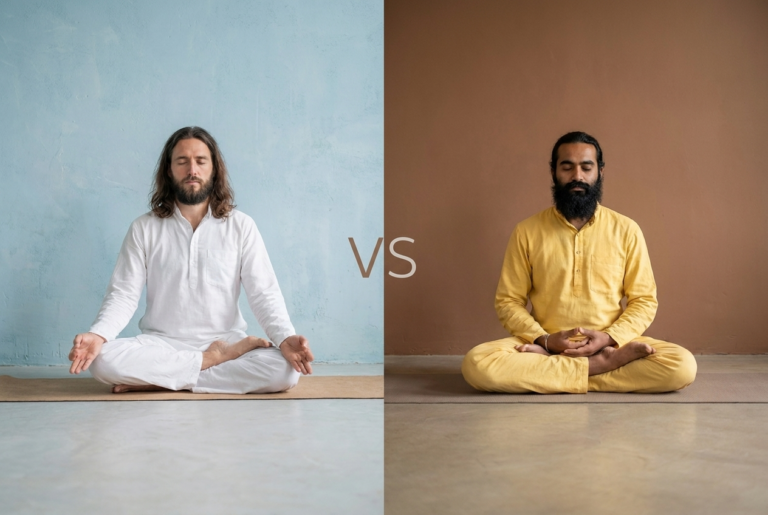
Are you Meditating Correctly?
If you are wondering whether you are meditating correctly, you are asking one of the most searched meditation questions in the world.
An analysis by Art of Living found “how do I know if I’m meditating correctly” drew around 35,000 searches a month globally, second only to “what is meditation” itself.
Thirty-five thousand people a month sit down, close their eyes, fail to stop thinking, and go looking for reassurance.
Here is something more useful than reassurance.
What Does Meditating Correctly Actually Mean?
Not a quiet mind. Meditating correctly means noticing when your attention has drifted and returning it, repeatedly, without judging yourself for having drifted.
The single most common misunderstanding is also the one that makes people quit.
Dan Harris, who wrote about coming to meditation as a skeptical television journalist, puts it bluntly. You really cannot hear this enough, he writes.
Meditation does not require you to stop thinking, and if you go in expecting to suspend all thought you are going to have a rough time of it.
The problem is structural. Most people cannot sit down and instantly clear their mind, so they conclude they are doing it wrong, or worse, that meditation simply is not for them.
But thinking is something you have done your entire life. Asking it to stop on command is asking for something no practice actually requires.
So redefine the goal. Not silence. Awareness of noise.
You are not trying to have fewer thoughts. You are trying to notice sooner than you are having one
What Brain Scans Show Happens When You Meditate?
A 2012 FMRI study mapped meditation as a repeating four-phase cycle. Mind wandering, noticing, shifting back, and sustaining focus, each tied to a different brain network.

This study is the most useful thing anyone worried about meditating correctly can learn.
Wendy Hasenkamp and colleagues at Emory University asked experienced practitioners to perform twenty minutes of breath-focused meditation inside an fMRI scanner, pressing a button whenever they realised their mind had wandered, then returning focus to the breath.
The button presses gave researchers the exact timing of naturally occurring moments of awareness.
What they found was a cycle. Four phases, over and over.
Mind wandering: Activity in the default mode network, the brain’s resting chatter, associated with self-referential thought.
Awareness: The moment you realise you have drifted. The salience network becomes strongly active.
Shift: Disengaging from the thought and returning to the breath. Executive control regions activate.
Focus: Sustaining attention on the breath. Sustained-attention networks engage.
The study appeared in NeuroImage in 2012, volume 59, pages 750 to 760, under the title Mind wandering and attention during focused meditation.
Here is why this matters to you. The moment you notice your mind has wandered is not the moment meditation failed. It is a distinct brain event with its own network. It is the practice.
Every time you catch yourself drifting, you completed a rep.
How Often Do Experienced Meditators Lose Focus?
About once every eighty seconds, averaged over a twenty-minute session, in the Hasenkamp study of experienced practitioners.
This is the number worth remembering.
A review in Frontiers in Human Neuroscience summarizing the research reports that participants recorded an average of one mind wandering per eighty seconds across a twenty-minute fMRI session, pressing a button each time they realized their mind had wandered completely away from the breath.
Twenty minutes contains fifteen eighty-second intervals. Experienced meditators, then, noticed roughly fifteen full departures in one sitting.
And that only counts the ones they caught.
The same review is candid about something important. The function of spontaneous thought in meditation is described as controversial, and how it should be handled depends on which kind of practice you are doing. Focused attention, open monitoring and loving-kindness approaches treat wandering differently.
So “meditating correctly” is partly a question of which method you are following. But in every method studied, wandering happens.
Nobody in the scanner achieved an empty mind.
What People Who Meditate Actually Say?
The accounts converge on the same moment. Realising you have drifted, feeling like you failed, and slowly discovering that the noticing was the point.
The experience is remarkably consistent, and it is worth hearing in people’s own words.
One writer described ten minutes on a cushion with unusual precision. Midway through, they begin wondering when it will be over.
Their attention goes to the timer on the phone beside them, and though their eyes are closed they can almost see the numbers. It must have been ten minutes by now. Perhaps the timer was set wrong. Perhaps they should stop and try again tomorrow.
Then the turn. They realise these are just thoughts, like the sound of cars passing outside. You do not chase cars down the street, so why chase thoughts.
Their description of what happens next is the best account of mind wandering anyone has written. Thoughts, they say, are like thieves after your consciousness.
They sneak in, they run out, and you chase them. When you catch up, they open their bags to show you their spoils, which turn out to be more thieves with more bags.
You fall down the rabbit hole until you figuratively smack yourself on the forehead, realise you have fallen for it again, and return to the breath.
And then this, arrived at independently: they had read somewhere that one measure of progress is gradually shortening the time it takes to realise you have been thinking.
That is exactly what the neuroscience shows.
A reader commenting on a meditation guide made the same discovery from the other direction. They said stopping their thoughts had always been an impediment for them, until they learned you are not supposed to stop thinking altogether.
Then, they said, it became much more approachable.
Neither of these people is an expert. Both of them worked it out. For a practice that makes the mind-wandering easier to work with, see our guide to chakra meditation for beginners.
What Progress Actually Looks Like?
Not fewer thoughts. Faster noticing and faster return. The gap between drifting and realising you have drifted gets shorter with practice.
This is the measurable part, and it is more encouraging than it sounds.
In the Hasenkamp work, activations during the cognitive phases were modulated by lifetime meditation experience.
The more practice someone had, the more their brain activity during each phase differed. Practice changes the cycle, even if it does not eliminate the wandering.
A later study found that two months of meditation practice produced sustained changes in brain functional networks, with the authors concluding the findings supported faster shifting of attention after practice.
Faster shifting. Not less wandering.
Research on the transition from state to trait changes has similarly examined how practice reconfigures the relationship between the default mode network and the central executive network over time.
The practical version. In your first weeks you might drift and not notice for two or three minutes. Months later, you might notice within seconds.
The drifting has not stopped. You simply catch it sooner.
That shortening gap is the actual evidence that you are meditating correctly.
Signs You Are Meditating Correctly
You notice when you drift. You return without berating yourself. The noticing gets faster over weeks. You are not trying to force thoughts away.
These are the markers worth tracking, drawn from teachers and practitioners.
You are catching the drift. Every time you realise your attention has left the breath, that is the practice working. Chade-Meng Tan, who designed Google’s mindfulness programme, describes this as the key insight.
There is no such thing as a bad meditation, he writes. When attention wanders away a great deal and you keep bringing it back, that is a good exercise, because every return gives your attention a chance to grow.
You are not scolding yourself. The Mind Illuminated, a widely used meditation manual, goes further than neutrality. When you notice wandering, it advises, take a moment to enjoy waking up from it. Savour being more present.
Congratulate yourself on noticing. It adds a line that removes much of the pressure: mind wandering happens automatically, there is no self in control of it, and therefore nobody to blame.
The return is gentle. When you meditating correctly, you bring attention back the way you would guide a puppy, not the way you would yank a leash.
You are consistent rather than intense. Ten minutes daily does more than an hour once a week.
Signs Something Needs Adjusting
Direct Answer: Falling asleep almost every session, straining to push thoughts away, feeling growing agitation, or holding your breath all suggest the approach needs changing.
“There is no wrong way to meditate” is reassuring and not quite true. Some patterns do signal a problem.
You are fighting your thoughts. Shunryu Suzuki, the Zen teacher, gave the clearest instruction on this. When practising, do not try to stop your thinking.
Let it stop by itself. If something comes into your mind, let it come in and let it go out. It will not stay long. When you try to stop your thinking, he said, it means you are bothered by it.
Effort aimed at suppressing thought usually produces more of it.
You fall asleep nearly every time. Occasional drowsiness is normal. Consistent sleep suggests you are too tired, meditating lying down, or at the wrong time of day. Try sitting upright, eyes slightly open, earlier in the day.
Agitation rises across sessions rather than settling. Meditation surfaces material, and for most people that is manageable. For some, particularly those with trauma histories, focusing inward intensifies distress.
If it gets worse rather than easier, change the technique or seek guidance. For a practice that makes the mind-wandering easier to work with, see our guide to chakra meditation for beginners.
You are controlling your breath without meaning to. Breath-focused meditation observes breathing rather than directing it. If you find yourself breathing deliberately, holding, or straining, relax back to natural breath.
For a practice that removes most of these problems, try yoga nidra, which is done lying down and guided throughout.
Key Takeaways for Readers
Get answers to your queries on mind wandering during meditation:
How do I know if I’m meditating correctly?
If you notice when your attention drifts and gently return it, you are meditating correctly. Meditation is not about achieving a quiet mind. A 2012 fMRI study found that even experienced meditators lost focus roughly once every eighty seconds. The noticing is the practice, and it activates a distinct brain network.
Is it normal for my mind to wander during meditation?
Completely. In the Hasenkamp study published in NeuroImage in 2012, experienced practitioners recorded an average of one mind wandering every eighty seconds during a twenty-minute session. Wandering is not failure. Noticing that you have wandered is the core exercise.Am I doing meditation wrong if I can’t stop thinking?
Am I doing meditation wrong if I can’t stop thinking?
No. Meditation does not require you to stop thinking. The goal is to become aware of your thoughts rather than lost in them. Trying to force thoughts away usually produces more of them. The Zen teacher Shunryu Suzuki advised letting thinking stop by itself rather than trying to stop it.
What happens in the brain during meditation?
Research by Hasenkamp and colleagues mapped a four-phase cycle. Mind wandering activates the default mode network. The moment of noticing activates the salience network. Returning attention and sustaining focus engage executive control and sustained-attention networks. The cycle repeats throughout a session.
How do I know if meditation is working?
The clearest sign is that you catch yourself drifting sooner. A study of two months of practice found changes in brain networks consistent with faster shifting of attention. You will not necessarily have fewer thoughts, but the gap between drifting and noticing gets shorter.
How long does it take to get better at meditation?
Research has found measurable changes in brain functional networks after two months of practice. Consistency matters more than duration. Ten minutes daily typically does more than an hour once a week.
Is it bad to fall asleep during meditation?
Occasionally, no. If it happens nearly every session, you may be too tired, meditating lying down, or practising at the wrong time of day. Try sitting upright with your eyes slightly open, earlier in the day.
Should I feel something when meditating correctly?
Not necessarily. Many sessions feel ordinary or restless, and that is normal. The benefit accumulates through repeated practice rather than through any particular feeling in a single session.
How many times should my mind wander in a meditation session?
There is no target. For reference, experienced meditators in an fMRI study noticed their minds wandering roughly fifteen times in twenty minutes, and those were only the times they caught. Beginners typically drift more and notice later. Both are normal.
References Used in this Article:
Skin Inc, reporting Art of Living search analysis. Top 10 Most Searched Questions about Meditation
https://www.skininc.com/science/research/news/22887713/top-10-most-searched-questions-about-meditation
Hasenkamp W, Wilson-Mendenhall CD, Duncan E, Barsalou LW. Effects of Meditation Experience on Functional Connectivity of Distributed Brain Networks, describing the 2012 study
https://ncbi.nlm.nih.gov/pmc/articles/PMC3290768
Hasenkamp W et al. Mind wandering and attention during focused meditation. NeuroImage 2012;59(1):750-760. DOI 10.1016/j.neuroimage.2011.07.008
https://buddhistuniversity.net/content/articles/mind-wandering-and-attention-during_hasenkamp-wendy-et-al
Frontiers in Human Neuroscience. Review of mind wandering in meditation, 2014
https://www.frontiersin.org/articles/10.3389/fnhum.2014.00086/full
The effect of 2-month meditation on brain functional networks. ISMRM Proceedings
https://cds.ismrm.org/protected/19MProceedings/PDFfiles/3894.html
From State-to-Trait Meditation: Reconfiguration of Central Executive and Default Mode Networks. eNeuro
https://www.eneuro.org/content/6/6/ENEURO.0335-18.2019
Something Daily. Meditating for 10 minutes, a first-person account
https://somethingdaily.substack.com/p/meditating-for-10-minutes
Seth Davis. Yes, you can meditate, including reader comments
https://sethdavis.substack.com/p/yes-you-can-meditate-start-by-ditching/comments
Harris D. Meditation for Fidgety Skeptics, reader highlight
https://www.goodreads.com/notes/36375515-meditation-for-fidgety-skeptics/2154537-luke/842947f0-ca26-44bf-b52d-83056e5d2f44
Tan CM. Search Inside Yourself, reader highlight
https://www.goodreads.com/notes/37761443-search-inside-yourself/43530801-chris-baker/6e302a47-75a5-44f1-8f6d-60922513975f
Suzuki S. Zen Mind, Beginner’s Mind, reader highlight
https://www.goodreads.com/notes/20734897-zen-mind-beginner-s-mind/43133569-neil/a5beda16-76fb-4a9e-b73f-b51b04ccb4dd
The Mind Illuminated, Stage Two study notes
https://brainscape.com/flashcards/stage-two-interrupted-attention-7930763/packs/13139645
Path to Peace Podcast. How Do I Know If I’m Meditating Correctly
https://www.goodreads.com/author_blog_posts/22260672-how-do-i-know-if-i-m-meditating-correctly-path-to-peace-podcast?tab=author