How to Start Meditation for Anxiety ?
Latest studies show that meditation reduces anxiety even in people who start with moderate to high anxiety symptoms. One randomized controlled trial found that mindfulness works as well as antidepressant medication for anxiety disorders. This guide explains what the science says and how to start meditation for anxiety without adding more pressure to your already overwhelmed mind.
The Essential Takeaway
Meditation is no longer viewed only as a spiritual practice. In 2025, multiple randomized controlled trials confirmed that mindfulness and breath focused meditation can significantly reduce anxiety symptoms, improve emotional regulation, and lower stress levels. Some studies even found mindfulness based interventions comparable to antidepressant medication for certain anxiety disorders. The most surprising part is how little time may be needed. One study involving 375 participants found that just 10 minutes of daily meditation for four weeks reduced anxiety scores significantly. Meditation does not eliminate anxious thoughts instantly. What it changes is your relationship with those thoughts. Over time, the nervous system becomes less reactive, the mind becomes steadier, and moments of calmness become easier to access.
Can Meditation Actually Reduce Anxiety?
Yes. Multiple randomized controlled trials published in 2025 confirmed that meditation for anxiety works significantly.
This question matters because anxious people often believe they are “too anxious” to meditate properly. They assume meditation only works for naturally calm people.
But the research suggests the opposite.
A 2025 randomized controlled trial published on PubMed found that Mindfulness Based Stress Reduction was statistically non inferior to escitalopram, a commonly prescribed antidepressant for anxiety disorders. In simple terms, mindfulness performed comparably to medication in reducing anxiety symptoms for many participants.
That does not mean meditation replaces medication for everyone. Some people benefit greatly from clinical treatment and should never stop prescribed medication without medical supervision.
What the study does show is something important:
Meditation is not merely a wellness trend. It produces measurable psychological effects. Another important detail is timing. Most studies found noticeable improvement within four to eight weeks of consistent practice.
That matters because anxious minds often expect immediate relief and then quit too early.
What Does 2026 Research Say About Meditation for Anxiety?
The 2025 research around meditation and anxiety is unusually strong compared to previous years.
A 2026 randomized controlled trial published in the Journal of Affective Disorders found that body awareness based digital exercises improved emotional regulation and reduced depressive symptoms among young adults.
Researchers noted that practices increasing interoceptive awareness, the ability to notice internal bodily states, helped participants regulate emotional overwhelm more effectively over time.
Another 2025 study published on PubMed examined online mindfulness interventions among patients with chronic diseases. Researchers found statistically significant reductions in anxiety scores at both four weeks and eight weeks.
A separate pilot randomized controlled trial explored savoring meditation, a practice focused on positive emotional awareness. Researchers found that both savoring meditation and breathing relaxation significantly reduced anxiety among participants with moderate to high anxiety symptoms.
What makes these findings important is consistency. Different meditation styles, different populations, and different delivery methods all showed similar emotional benefits.
Is Meditation as Effective as Medication for Anxiety?
This is probably the most searched question around meditation and anxiety right now. And the answer requires nuance.
A 2025 randomized controlled trial comparing mindfulness to escitalopram found that Mindfulness Based Stress Reduction was “non inferior” to the medication for treating anxiety disorders.
The phrase “non inferior” has a specific scientific meaning. It means mindfulness performed comparably rather than significantly worse. That is a major finding. But it is important not to oversimplify it.
Medication can work faster for some individuals, especially during severe anxiety episodes. Clinical treatment may also be necessary for panic disorders, trauma related conditions, or debilitating anxiety symptoms.
Meditation works differently. Instead of suppressing symptoms directly, mindfulness changes how the nervous system responds to anxious thoughts and emotional triggers over time.
What most articles miss about this comparison is that meditation and medication are not always competing solutions. Sometimes they work best together. And importantly, no one should stop prescribed medication without speaking to a licensed medical professional first.
What Type of Meditation Works Best for Anxiety?
Focused attention meditation is currently the most researched style for anxiety reduction, especially for beginners.
This practice usually involves focusing gently on the breath and returning attention whenever the mind wanders. Simple sounds boring. But neurologically, something important is happening.
A 2025 systematic review published through MIT Press examined the neurophysiological effects of focused attention meditation. Researchers found increased alpha, beta, and gamma brain wave activity associated with improved attention regulation and cognitive control.
Other styles also showed strong results:
- Savoring meditation focused on positive emotional states
- MBSR programs combining body awareness and mindfulness
- Breathing relaxation techniques
For beginners, focused attention meditation remains the easiest starting point because it provides a clear anchor. The breath becomes something stable to return to when anxiety pulls attention into spiraling thoughts.
Readers struggling with racing thoughts may also find value in our article – why I can’t meditate.
How Long Does It Take for Meditation to Reduce Anxiety?
This is one of the most misunderstood parts of meditation. Many beginners expect dramatic calmness after one or two sessions. When that does not happen, they assume meditation “is not working.”
But the research shows a different timeline. The teacher study involving 375 participants found measurable anxiety reduction after four weeks of 10 minute daily meditation sessions.
Additionally, one chronic disease mindfulness study found significant improvement at both four weeks and eight weeks. That pattern appears repeatedly in mindfulness research. Results build gradually.
The nervous system does not instantly forget years of stress conditioning. Meditation works more like physical exercise than emergency sedation. Consistency matters more than long sessions.
Five to ten minutes practiced regularly often works better than occasional one hour sessions done inconsistently. And sometimes the first sign of progress is subtle. You may simply notice that anxious thoughts recover slightly faster than before.
Can a 10 Minute Daily Meditation Help with Anxiety?
Yes. In fact, some of the strongest 2025 evidence comes from short daily meditation practices.
A 2026 study published through Springer also found that short daily movement and mindfulness related interventions reduced cortisol levels while improving stress and anxiety symptoms among young adults. Researchers emphasized that consistency mattered more than intensity.
That matters because many anxious people avoid meditation for one reason:
It feels overwhelming. Long meditation sessions can sound intimidating when someone already feels mentally exhausted. Short sessions are different. They feel possible.
And sustainability matters more than intensity. Ten quiet minutes practiced daily can slowly retrain attention, breathing patterns, and emotional reactivity.
What most anxious beginners need is not a perfect meditation routine.
They need a routine they can actually continue. If you are completely new to meditation, this guide may help: how to start daily meditation.
How to Start a Meditation Practice for Anxiety
The biggest misconception about meditation is that the goal is to stop thinking. It is not. The practice is returning attention gently whenever the mind wanders. That return itself is the training. Here is the simplest place to begin.
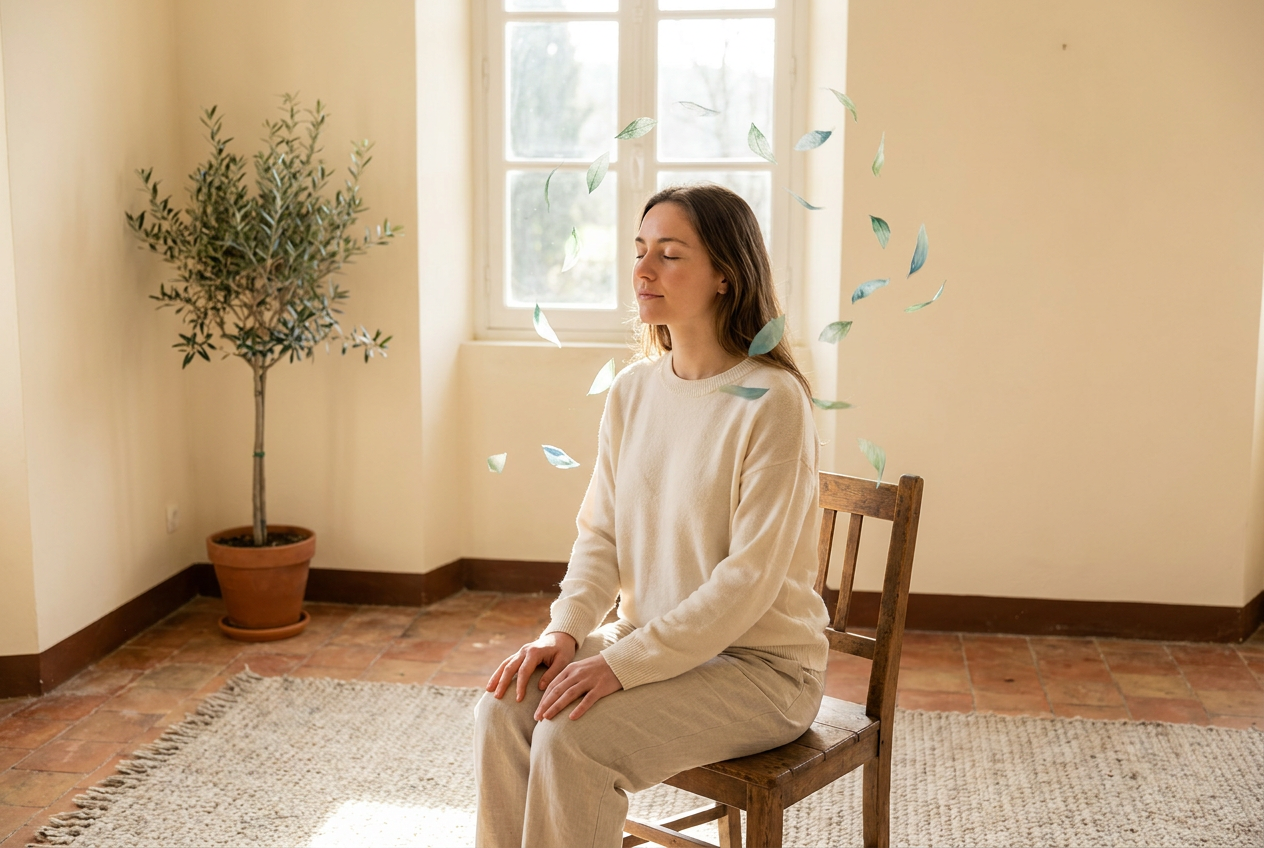
Sit comfortably. A chair is completely fine. You do not need a special posture. Close your eyes or soften your gaze. Notice your breathing without trying to control it.
Your attention will drift. That is normal. When you notice distraction, gently return attention to the breath again. That moment is not failure. That moment is meditation. Start with five minutes daily.
Then slowly increase if it feels natural. A 2025 review of focused attention meditation found that breath awareness practices improve cognitive control and emotional regulation over time.
Summary: What the Science Says About Meditation for Anxiety
| Question | What Research Says |
|---|---|
| Does meditation reduce anxiety? | Yes. Multiple 2025 randomized controlled trials confirmed significant reduction in anxiety symptoms |
| Is it comparable to medication? | Mindfulness Based Stress Reduction performed comparably to escitalopram for some anxiety disorders |
| How much meditation is needed? | As little as 10 minutes daily for four weeks showed measurable benefits |
| Which meditation works best? | Focused attention meditation, MBSR, and savoring meditation all showed strong results |
| How long until results appear? | Most studies found improvement between four and eight weeks |
| Can beginners do it? | Yes. Many studies used novice meditators with no prior experience |
| Is it safe? | Generally safe, but medication changes should only happen under medical supervision |
FAQs
Can meditation make anxiety worse at first?
Sometimes yes. When people first sit quietly, they may become more aware of anxious thoughts they were previously distracting themselves from. This does not mean meditation is failing. It often means awareness is increasing before regulation improves.
Is guided meditation better for anxiety beginners?
For many beginners, yes. Guided meditation provides structure and reassurance, which can reduce the fear of “doing it wrong.”
What is the best time to meditate for anxiety?
There is no universal perfect time. Many people prefer mornings for nervous system stability, while others meditate before sleep to reduce mental overstimulation.
Can breathing exercises reduce anxiety quickly?
Slow breathing can activate the parasympathetic nervous system and reduce physical anxiety symptoms relatively quickly. However, long term regulation usually improves through consistent practice.
Do I need complete silence to meditate?
No. Meditation can still work in imperfect environments. The goal is not perfect silence but gentle attention training.
Can meditation replace therapy?
Not necessarily. Meditation can support emotional regulation, but severe anxiety, trauma, or panic disorders may still require professional mental health care.
What Does This Mean for You?
Anxiety often makes people feel trapped inside their own minds. Meditation does not magically erase anxious thoughts. What it slowly changes is your relationship with them.
That shift matters more than most people realize. Even short daily mindfulness practices can measurably change emotional regulation, stress response, and nervous system reactivity over time.
And perhaps the most comforting part is this: You do not need to become perfectly calm before meditation starts helping you. You simply need to begin.
References
- The unique autonomic signatures of savoring meditation for anxiety reduction: A pilot randomized controlled trial
https://pubmed.ncbi.nlm.nih.gov/40367767/ - A randomized controlled trial comparing mindfulness to escitalopram for anxiety
https://pubmed.ncbi.nlm.nih.gov/40324655/ - Brief Mindfulness Meditation via Video Streaming Improves Depression, Anxiety, and Perceived Stress Among Schoolteachers
https://onlinelibrary.wiley.com/doi/abs/10.1002/pits.70040 - Effect of online mindfulness intervention on anxiety, depression, and stress in patients with chronic diseases
https://pubmed.ncbi.nlm.nih.gov/40683216/ - Neurophysiological mechanisms of focused attention meditation: A scoping systematic review
https://direct.mit.edu/imag/article/doi/10.1162/IMAG.a.14/130698/Neurophysiological-mechanisms-of-focused-attention - Cortisol, Anxiety, and Exercise Regulation Study (2026)
https://link.springer.com/article/10.1186/s13102-026-01699-5 - Digital Interoceptive Enhanced Exercise and Depression Study (2026)
https://www.sciencedirect.com/science/article/abs/pii/S0165032726006841