Meet Robot Monk Gabi From South Korea
In 2026, Gabi became part of a Buddhist precept ceremony at Jogyesa Temple in Seoul, raising a question that now matters far beyond South Korea. Can a machine help preserve teachings, guide seekers, and support rituals, while still remaining only a tool?
South Korea’s robot monk Gabi is not just a strange technology story. It is a sign of something much bigger: spiritual institutions are beginning to ask whether AI can support religious practice without replacing human wisdom.
The Essential Takeaway
Robot monk Gabi shows how AI is entering spiritual life in visible, symbolic ways. In 2026, South Korea’s Jogye Order introduced Gabi during a Buddhist ceremony at Jogyesa Temple in Seoul, where the humanoid robot received adapted precepts and joined monks in ritual practice. The deeper issue is not whether a robot can become enlightened. It is whether AI can responsibly support teaching, ritual access, ethical reflection, and spiritual education without weakening human connection. Gabi represents both promise and concern: AI can make spiritual knowledge more accessible, but it cannot replace lived experience, compassion, suffering, silence, or the presence of a human teacher.
What Is Gabi, the Robot Monk from South Korea?
Gabi is a humanoid robot monk introduced by South Korea’s Jogye Order of Korean Buddhism in 2026 as part of a symbolic experiment in faith and technology.
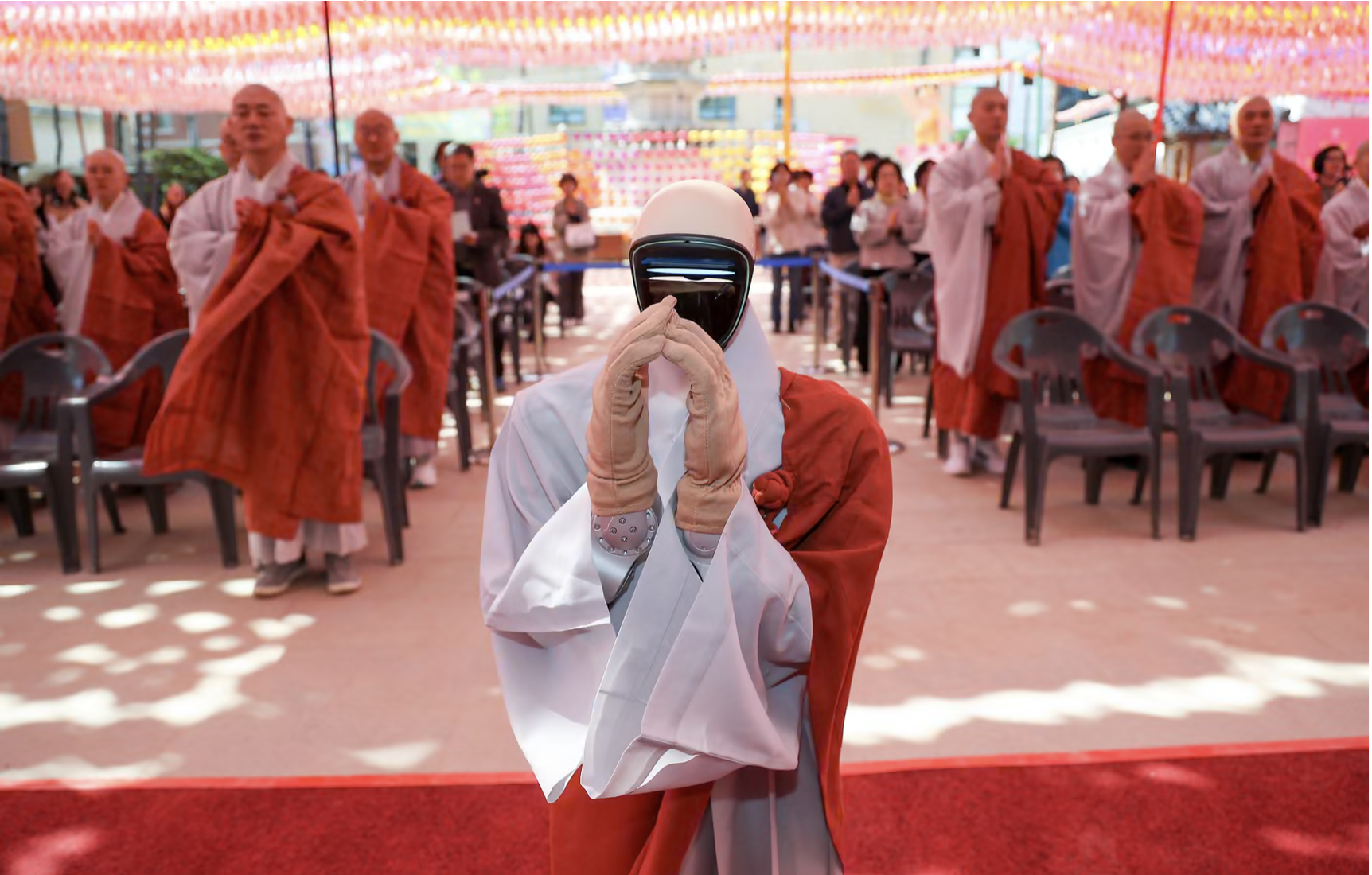
The robot appeared at Jogyesa Temple in Seoul during a Buddhist precept ceremony connected to Buddha’s Birthday celebrations. Reports described Gabi as a roughly 130 centimeter humanoid robot dressed in traditional monastic robes, able to bow, respond to ritual prompts, and participate in ceremonial moments.¹
Gabi is a South Korean humanoid robot monk created to explore how robotics and artificial intelligence may coexist with Buddhist ritual, education, and public engagement.
What matters here is not that Gabi is spiritually awakened. It is not. The significance is symbolic. A robot entering a temple ceremony forces religious communities to examine what parts of faith can be assisted by technology and what parts must remain deeply human.
According to a report from The Korea Times, Buddhist leaders presented Gabi not as a replacement for monks, but as a symbolic exploration of coexistence between humans and intelligent machines.
Gabi is more about testing the boundary between ritual performance and inner realization.
Why Did a Buddhist Temple Create a Humanoid Robot Monk?
The temple created Gabi to explore how Buddhism can communicate with younger generations living in a technology centered world.
In 2026, South Korean Buddhist leaders were already facing the challenge of declining religious participation among younger people. A robot monk naturally attracts attention because it speaks the language of robotics, AI, social media, and youth curiosity.
A feature published by Smithsonian Magazine explained that Buddhist institutions in South Korea have increasingly experimented with digital outreach and technology assisted teaching.
But Gabi is not only a marketing device. It also raises a serious question: Can technology help people become curious about teachings they might otherwise ignore?
Our team, writing in the context of modern spiritual culture, describe Gabi as a “gateway symbol.” His relevance to this topic comes from observing how younger seekers often meet spirituality first through media, technology, or public moments before moving toward deeper practice.
The risk is obvious. If the robot becomes the message, spirituality becomes spectacle. But if the robot opens a door toward reflection, it may serve a useful role.
What Spiritual Vows and Precepts Were Given to a Robot?
Gabi reportedly received adapted Buddhist precepts during the 2026 ceremony, including vows shaped for a non human participant.
According to media reports, the robot promised to obey humans, save energy, and treat other robots peacefully. These are not traditional monastic vows in the full human sense. They are symbolic adaptations meant to translate Buddhist ethical principles into the language of robotics.
A report from Interesting Engineering noted that the vows were intentionally designed to start conversation around AI ethics rather than imply true spiritual awakening.
This is where the story becomes philosophically interesting.
A human takes vows with intention, fear, desire, discipline, memory, and moral struggle. A robot follows programming. So when a robot receives vows, the action is not about the robot’s inner transformation. It is about human beings asking what ethical behavior should mean in an age of machines.
A spiritual vow is meaningful in human practice because it involves intention, self restraint, awareness, and moral responsibility.
Gabi’s vows matter because they turn AI ethics into ritual language. Instead of asking only whether robots should be efficient, the ceremony asks whether they should be harmless, restrained, and aligned with human wellbeing.
How Is Gabi Designed to Interact with Worshippers?
Gabi is designed to interact with worshippers through gesture, speech, ritual participation, and public presence.
In 2026 reports, Gabi bowed before monks, wore Buddhist robes, responded to ceremonial prompts, and joined Buddhist events in Seoul. The Korea Times described the ceremony as part of a broader attempt to explore coexistence between humans and robots as AI becomes more present in daily life.
This kind of interaction can be useful at a basic level.
A robot can answer common questions. It can explain temple rules. It can guide visitors through simple rituals. It can repeat teachings consistently without fatigue.
But spiritual interaction is not the same as information delivery.
A human teacher notices tone, hesitation, grief, confusion, ego, and longing. A robot may detect patterns, but it does not suffer. It does not seek liberation. It does not know silence from the inside.
That distinction is essential.
AI may assist worshippers, but it cannot fully accompany them in the deepest human sense.
Is Gabi a Sign of a Larger Trend of AI in Spirituality?
Yes, Gabi is part of a much larger 2024 to 2026 trend: religious communities are experimenting with AI as a tool for teaching, ethics, outreach, and spiritual conversation.
In 2026, the Associated Press reported that technology leaders and religious figures were increasingly meeting to discuss how faith traditions might help shape ethical AI. The conversation now includes Buddhism, Christianity, Islam, Sikhism, and other traditions.⁵
Academic interest is growing too. A 2025 review in the journal Religions examined recent research on AI and religion, showing that scholars are increasingly focused on how AI affects belief, ritual, authority, and religious identity.⁶
What most articles miss about AI in spirituality is that religion is not simply “using” AI. AI is also forcing religion to restate what makes human spiritual life unique.
That may be the real value of Gabi. The robot does not answer the question of faith. It makes the question sharper.
How Could AI and Robots Change Religious Practice?
AI could change religious practice by making spiritual education more accessible, personalized, and available outside traditional institutions.
By 2027, AI tools are already being used for scripture search, meditation guidance, sermon drafting, ritual explanation, language translation, and spiritual chat interfaces. For people who live far from teachers or temples, this could be genuinely helpful.
A robot monk like Gabi points toward a future where temples may use AI assistants to welcome visitors, explain teachings, translate chants, guide children, or preserve oral traditions.
But the change will not be neutral.
Religious authority may become more complicated. If an AI explains scripture, whose interpretation is it using? If a chatbot gives spiritual advice, who is responsible when it harms someone? If a robot performs ritual, does the community feel supported or unsettled?
AI can scale information. It cannot automatically scale wisdom.
The healthiest future may be one where AI handles repetition, access, and education, while human teachers preserve discernment, compassion, and lived spiritual presence.
Our article on common meditation problems for beginners explores why real spiritual growth still depends on direct human experience and self observation.
What Are the Ethical Questions About AI in Spirituality?
The biggest ethical question is whether AI can support spirituality without reducing it to automation.
A 2025 academic discussion on AI and religion warned that AI can help spiritual engagement but also risks depersonalization, bias, misinformation, and commercialization of sacred experience.⁷
This matters because faith is not just content. It is relationship.
A monk is not only someone who delivers information. A teacher carries discipline, lineage, suffering, practice, and accountability. A machine can imitate the outer form, but it cannot possess human vulnerability or spiritual realization.
There are also practical concerns.
Who programs the robot’s beliefs? Which version of Buddhism does it represent? Can it answer grief with enough care? Can it handle trauma? Should children be taught by machines in sacred settings?
The ethical answer is not to reject AI completely. The better answer is to place limits around it.AI can be a lamp. It should not pretend to be the light itself.
Summary: Key Facts About Robot Monk Gabi & AI Spirituality
| Potential Benefit | Potential Concern |
|---|---|
| Preserves teachings when human clergy is scarce | Lacks genuine empathy and lived human experience |
| Makes rituals and information more accessible | Reduces authentic human to human spiritual connection |
| Can answer frequently asked questions consistently | Risks oversimplifying complex philosophical concepts |
| Attracts younger, tech savvy generations | Raises ethical questions about programming “belief” |
| Can operate without fatigue or personal bias | Could replace human roles in religious institutions |
FAQs
What is robot monk Gabi?
Gabi is a humanoid robot monk introduced by South Korea’s Jogye Order in 2026. It appeared at Jogyesa Temple in Seoul during a Buddhist precept ceremony, wearing monastic robes and participating in ritual gestures. Gabi is best understood as a symbolic experiment in AI, robotics, and Buddhist public engagement rather than a spiritually realized being.
Can a robot truly become a monk?
A robot can be given symbolic robes, ritual roles, and programmed responses, but it cannot become a monk in the full human spiritual sense. In 2026, Gabi’s ceremony raised this question directly. A human monk takes vows with intention, discipline, awareness, and moral struggle. A robot performs instructions based on programming.
Why are religious groups experimenting with AI?
Religious groups are experimenting with AI because younger generations increasingly live in digital environments. In 2024 to 2026, faith communities began exploring AI for education, translation, outreach, ethics, and public engagement. The goal is often not to replace teachers, but to make spiritual teachings more accessible.
Is AI in spirituality dangerous?
AI in spirituality can be risky if it replaces human guidance, gives poor advice, spreads biased interpretations, or commercializes sacred experience. But it can also be useful when limited to education, access, translation, and administrative support. The key issue in 2026 is not whether AI should be used, but where its boundaries should be.
What does Gabi reveal about the future of faith?
Gabi shows that faith traditions are entering a new technological phase. Spiritual institutions may increasingly use AI to engage younger audiences, preserve teachings, and answer basic questions. But Gabi also reveals what AI cannot replace: lived wisdom, compassion, silence, moral responsibility, and genuine human presence.
Can AI help with meditation or spiritual practice?
Yes, AI can help beginners with meditation timers, guided prompts, scriptural explanations, journaling questions, and reminders. But in 2026, AI should still be treated as a support tool. It can guide attention, but it cannot experience awakening, compassion, or inner transformation on behalf of the seeker.
What significance Gabi will have ?
Gabi, South Korea’s robot monk, is not important because a machine has become spiritual. It is important because humans are now asking what spirituality means in an age of intelligent machines.
AI may help preserve teachings, answer basic questions, and make spiritual spaces more accessible. But the deepest parts of faith still require human presence, silence, compassion, and lived transformation.
Explore more reflections on consciousness, technology, and modern spirituality on The Inner Path.
References
- The Korea Times. Buddhist sect welcomes humanoid robot Gabi with precept ceremony. 2026.
https://www.koreatimes.co.kr/southkorea/society/20260506/buddhist-sect-welcomes-humanoid-robot-gabi-with-precept-ceremony - Smithsonian Magazine. Meet Gabi, the Robot That Just Became a Monk at a Buddhist Temple in South Korea.2026.
https://www.smithsonianmag.com/smart-news/meet-gabi-the-new-robot-monk-at-a-buddhist-temple-in-south-korea-its-the-latest-robot-to-take-up-religious-practice-180988695/ - Interesting Engineering. South Korea’s robot monk Gabi joins Buddhist ceremony, takes vows at temple. 2026.
https://interestingengineering.com/ai-robotics/south-korea-robot-monk-gabi-buddhist-ceremony - Associated Press. Tech is turning increasingly to religion in a quest to create ethical AI. 2026.
https://apnews.com/article/053a44133c64703f83fd50c9ee6124ea - Religions Journal. Wisdom of the Heart: A Contemporary Review of Religion and AI. 2025.
https://www.mdpi.com/2077-1444/16/7/834 - Scientia et Fides. Artificial Intelligence and Spirituality: A Tool for Engagement or a Challenge to Human Transcendence? 2025.
https://apcz.umk.pl/SetF/article/view/60310