India Mental Health Crisis 2026
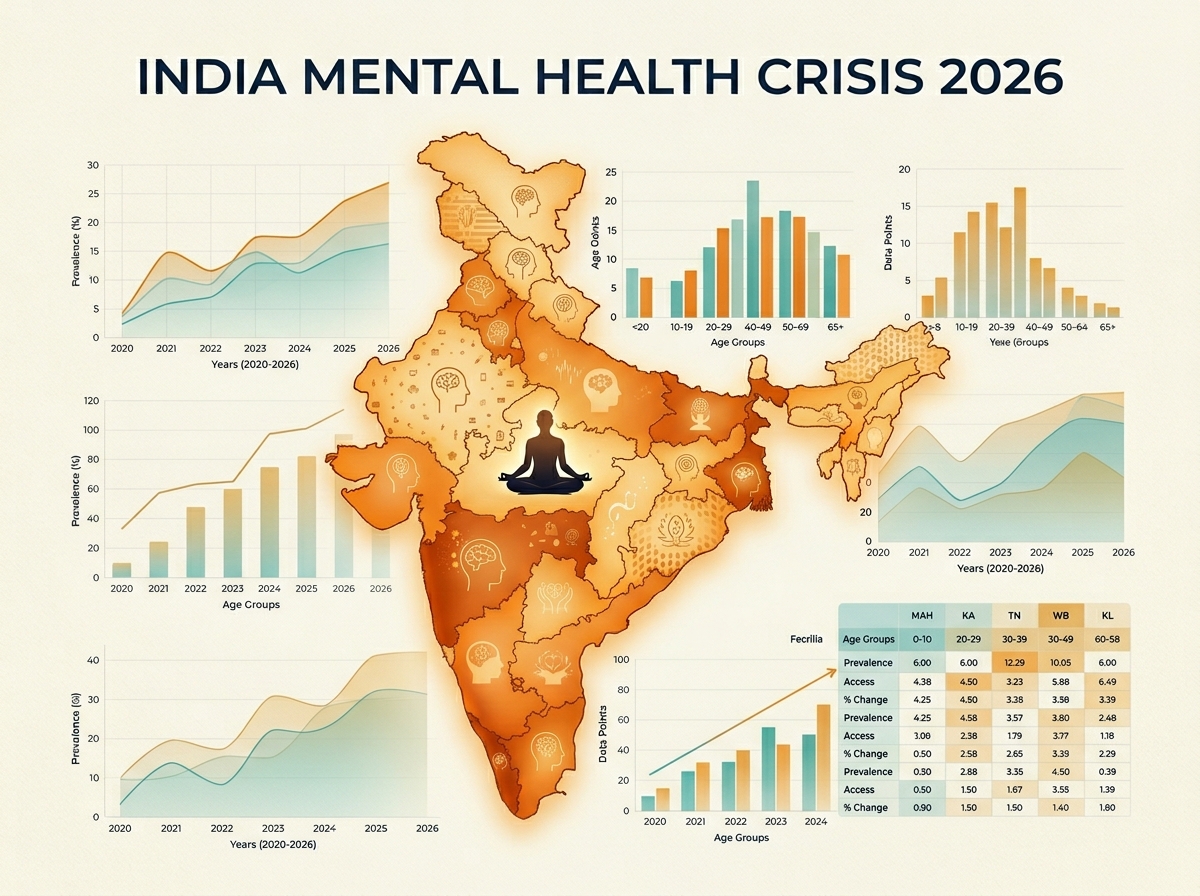
India is facing a mental health crisis of unprecedented scale. According to the latest 2025 and 2026 data, 197 million Indians live with some form of mental illness. That is more than the population of Brazil. One in every 11 Indians is affected, and nearly 15% of adults need mental health interventions they are not receiving. The treatment gap now stands between 80% and 85%, meaning the vast majority of people suffering from anxiety, depression, burnout, or emotional distress still do not receive timely care.
The India mental health crisis is no longer hidden. It is visible in schools, workplaces, families, hospitals, and increasingly among younger Indians under 35. The bigger question now is not whether India has a mental health crisis. The question is whether the current healthcare system can realistically keep up with it.
The Essential Takeaway
India’s mental health crisis has reached a scale that experts now describe as a public health emergency. Between 2025 and 2026, multiple reports confirmed that nearly 197 million Indians require mental health support while 80% to 85% still remain untreated. Young Indians under 35 are the most affected demographic, driven by academic pressure, career instability, loneliness, social media stress, and economic uncertainty. At the same time, India continues to face a severe shortage of psychiatrists, psychologists, and affordable care systems. New research and government initiatives now suggest that meditation, yoga, emotional wellness practices, and preventive mental health education may become essential tools in bridging the widening treatment gap.
How Many Indians Need Mental Health Support in 2026?
Nearly 197 million Indians are living with some form of mental illness, making the India mental health crisis one of the largest public health challenges in the world.
According to recent 2026 reports, nearly 197 million Indians are living with some form of mental illness. Government linked surveys now estimate that one in every 11 Indians is affected by a mental health condition. Nearly 15% of adults require some level of mental health intervention.
To understand the scale:
- 197 million is larger than the population of Brazil
- More than twice the population of Germany
- Nearly four times the population of Canada
This is no longer a niche healthcare issue. It is a national wellbeing crisis.
A 2025 report discussing the growing awareness gap among young Indian adults highlighted that emotional distress, anxiety, and untreated psychological conditions are becoming increasingly normalized among younger populations rather than treated early.
Meanwhile, a Business Standard report published in 2025 emphasized that 197 millions of Indians still lack access to timely support despite growing awareness around mental health.
What makes this even more concerning is that awareness is growing faster than the healthcare system itself.
What Is the Treatment Gap and Why Is It Widening?
The treatment gap in the India mental health crisis now ranges between 80% and 85% for common mental health disorders.
That means: If 100 Indians experience anxiety, depression, burnout, or emotional distress, only about 15 to 20 receive meaningful treatment. The remaining people struggle alone. The reasons are deeply structural.
India continues to face:
- Severe shortage of psychiatrists
- Limited mental health infrastructure
- Social stigma
- High private therapy costs
- Overcrowded public healthcare systems
An Economic Times Health report from 2025 highlighted that India faces a major manpower shortage in mental healthcare even as awareness and diagnosis continue rising.
Government hospitals are increasingly overwhelmed, especially in urban areas where emotional stress among younger populations is rising sharply.
What most people miss about India’s mental health crisis is that awareness alone does not solve suffering. Awareness without accessible support can actually increase emotional frustration because people recognize their struggles but still cannot access affordable help.
Young Indians Under 35 Most Affected
One of the most worrying patterns emerging from the latest data is age. Nearly 60% of diagnosed mental health conditions are now being reported among Indians under the age of 35.
This generation is carrying pressures previous generations never experienced at this scale.
Academic competition begins earlier. Career uncertainty lasts longer. Social media creates nonstop comparison. Economic independence arrives later. Emotional isolation continues increasing even in hyperconnected digital environments.
Amit S., 31 years old, IIM Ranchi (2025), currently working as Manager of HRM at Tata Steel, earning more than one lakh per month, has been diagnosed with depression. The key reasons were academic competition, the drop year he took for preparation, emotional isolation because of distance from family and peers, and career uncertainty. He is now looking for a job with a lower package, almost half, but near his hometown.Disclaimer: The name and certain identifying details have been changed to protect the individual’s privacy. The experiences shared are real and have been included with informed consent.
For many young Indians like Amit, life feels constantly accelerated.
A mental health conclave hosted by NIMHANS in Bengaluru during 2025 discussed how emotional burnout, loneliness, digital dependency, and anxiety are becoming central concerns among younger populations.
Premanand Maharaj once said:
“The mind becomes tired long before the body does.”
That line feels increasingly relevant today. Many young adults are not physically exhausted first. They are emotionally exhausted first.
You may also be interested in: Why Are Young Indians Depressed?
What Are the Real Barriers to Mental Health Care in India?
The biggest barrier is not willingness. It is accessibility. India currently has approximately 0.75 psychiatrists per 100,000 people, while the WHO recommendation stands at around 3 psychiatrists per 100,000 people.
The shortage becomes even more severe in smaller towns and rural areas.
For many Indians:
- Therapy is financially unaffordable
- Public hospitals are overcrowded
- Waiting periods are long
- Qualified professionals remain inaccessible
A 2025 report from Funds for NGOs discussing India’s widening mental health crisis explained how infrastructure shortages and funding gaps continue preventing millions from accessing support.
Another Government of India document published in February 2025 emphasized the growing need for community based mental health awareness and preventive interventions. This is where the conversation around meditation becomes important.
Not as a replacement for clinical treatment. But as something scalable, preventive, accessible, and culturally familiar.
Can Yoga and Meditation Help Bridge the Gap?
Meditation alone cannot solve India’s mental health crisis. But it may become one of the most practical large scale support systems available. That matters because India’s healthcare infrastructure simply cannot scale fast enough to meet current demand.
Meditation and yoga offer several advantages:
- Low cost
- Community friendly
- Preventive rather than reactive
- Easy to practice daily
- Familiar within Indian culture
More importantly, newer government initiatives are slowly shifting from an illness only model toward emotional wellness and prevention based approaches.
One striking example is the Chhattisgarh government’s decision to offer paid leave for meditation. In April 2026, the state announced that employees could take up to 12 days of fully paid leave to attend Vipassana retreats. Employees remain officially “on duty” during the retreat and can use this provision up to six times in their career.
This policy reflects a quiet but meaningful shift. A state government is publicly recognizing that mental stillness matters, not just for spiritual seekers but for ordinary working people.
The National Mental Health Survey 2 now includes broader wellbeing indicators instead of focusing only on severe psychiatric illness. That shift is important.
It recognizes something many spiritual traditions understood long ago: mental wellbeing is not only about treating crisis after collapse. It is also about building emotional resilience before collapse happens.
What Does the Latest Research Say About Meditation for Mental Health?
The research is becoming increasingly difficult to ignore.
A 2025 study published in the Indian Journal of Public Health Research and Development compared people who regularly practiced yoga and meditation with non practitioners. Researchers found significantly higher quality of life scores across physical health, psychological wellbeing, social relationships, and environmental health among meditation practitioners.
The results were statistically significant across all measured categories. Practitioners also showed lower odds of chronic co morbid conditions. Another growing area of research involves emotional regulation and stress resilience.
A 2025 mindfulness study published on National Library of Medicine found that momentary mindfulness was strongly associated with healthier emotional regulation patterns among adolescents and young adults.
Meanwhile, a 2026 randomized controlled trial published on ScienceDirect found that body awareness based exercises improved emotional regulation and reduced depressive symptoms among young adults.
What makes these studies important is not that meditation eliminates suffering instantly. It is that regular practice appears to change how people respond internally to stress, anxiety, and emotional overload over time.
Summary: What the 2025 and 2026 Data Means for India Mental Health Crisis
| Question | What the Data Says |
|---|---|
| How many Indians need mental health support? | 197 million Indians |
| What is the treatment gap? | 80% to 85% remain untreated |
| Who is most affected? | Indians under 35 |
| Biggest barrier? | Shortage of affordable professionals |
| Can meditation help? | Research shows measurable improvement in emotional wellbeing |
| What is changing now? | Shift toward preventive emotional wellness models |
FAQs
How serious is India’s mental health crisis in 2025?
Very serious. Nearly 197 million Indians are estimated to need mental health support, while most still remain untreated due to infrastructure shortages and accessibility barriers.
Why are young Indians more affected by anxiety and burnout?
Experts increasingly point toward academic pressure, digital overstimulation, social comparison, economic uncertainty, and emotional isolation as major contributing factors.
Is meditation scientifically proven to help mental health?
Yes. Multiple 2025 and 2026 studies found meditation and mindfulness practices improve emotional regulation, stress resilience, and overall psychological wellbeing.
Can meditation replace therapy or psychiatric treatment?
No. Meditation can support emotional wellbeing and prevention, but severe mental health conditions may still require professional medical treatment.
Why is the treatment gap so high in India?
India faces shortages of psychiatrists, psychologists, affordable care systems, and public mental health infrastructure, especially in rural areas.
What Does This Mean for India’s Future?
India mental health crisis is no longer invisible. The numbers are now too large, too widespread, and too emotionally visible to ignore.
At the same time, the current healthcare system cannot realistically solve this crisis through medication and clinical treatment alone. The infrastructure gap is simply too large. That means the future of mental wellbeing in India will likely depend on a combination of:
- Better professional healthcare systems
- Preventive emotional education
- Community support
- Meditation and yoga based wellness practices
- Early intervention instead of late stage crisis treatment
The deeper question may no longer be: “Should mental health matter?”
The real question now is:
How long can society afford to ignore emotional wellbeing before the consequences become impossible to reverse?
References
- THIP Media. (2026, January 28). Awareness gap fuelling mental health disorders in young Indian adults. https://www.thip.media/news/awareness-gap-fuelling-mental-health-disorders-in-young-indian-adults-experts/137286
- Economic Times Health. (2025, August 5). India faces manpower shortage amid deepening mental health crisis. https://health.economictimes.indiatimes.com/news/industry/india-faces-manpower-shortage-amid-deepening-mental-health-crisis/123112477
- Business Standard. (2025, October 10). 197 million Indians need mental health support: Here’s what’s missing. https://www.business-standard.com/health/197-million-indians-need-mental-health-support-here-s-what-s-missing-125101000277_1.html
- Deccan Herald. (2026, March 26). Bengaluru: NIMHANS hosts conclave on mental health survey. https://www.deccanherald.com/india/karnataka/bengaluru/bengaluru-nimhans-hosts-conclave-on-mental-health-survey-3944857
- Indian Journal of Public Health Research and Development. (2025, April-June). IJPHRD Vol. 16 No. 2. https://ijphrd.com/scripts/IJPHRD%20Vol.%2016%20No.%202%20April-June%202025_Final.pdf#87#78
- fundsforNGOs News. (2025, October 10). Mental health in India: 197 million people need help – what’s missing?. https://news.fundsforngos.org/2025/10/10/mental-health-in-india-197-million-people-need-help-whats-missing/
- Press Information Bureau, Government of India. (2025, February 7). Advancing mental healthcare in India. Ministry of Health and Family Welfare. https://static.pib.gov.in/WriteReadData/specificdocs/documents/2025/feb/doc202527497201.pdf
- National Institute of Mental Health and Neurosciences (NIMHANS). (2026). *National Mental Health Survey of India 2025-26*. https://indianmhs.nimhans.ac.in
- Aku, Y., Jin, Y., Qu, D., Yang, C., Wu, W., An, J., & Chen, R. (2026, September 1). Digital interoceptive-enhanced exercise for young adults with depression: A randomized controlled trial. Journal of Affective Disorders, 408, 121833. https://www.sciencedirect.com/science/article/abs/pii/S0165032726006841
- PubMed Central (PMC). (2025). Mindfulness and emotion regulation study (PMCID: PMC12757435). https://pmc.ncbi.nlm.nih.gov/articles/PMC12757435/
- Shilpa, Vishnu, M. V., Bharadwaj, A., Chaithra, K., Reddy, K. D., & Jha, R. (2025, March 11). Physical, mental and social health of the people who practice yoga and meditation – A comparative study. Indian Journal of Public Health Research and Development, 16(2). https://medicopublication.com/index.php/ijphrd/article/view/21805