Why Are Young Indians Depressed?
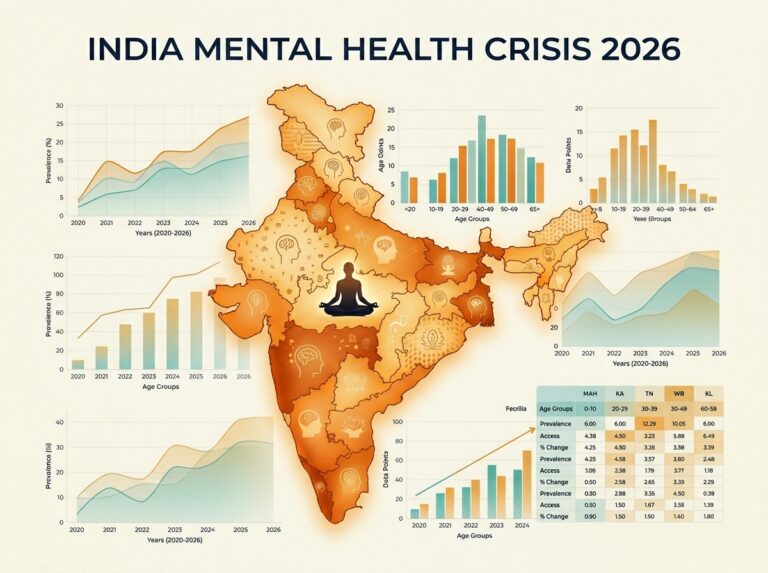
Depression in young Indians has reached a critical level. Young adults in India are struggling with their mental health like never before. According to the Global Mind Health in 2025 report by Sapien Labs, Indians aged 18 to 34 ranked 60th out of 84 countries on key mental wellbeing parameters, with an average Mind Health Quotient score of 33, placing them in the “Distressed or Struggling” range. Older Indians aged 55 and above scored much higher, close to 96, showing a sharp generational gap.
This is not just about anxiety or sadness. It points to a wider decline in emotional regulation, focus, relationship stability, and recovery from stress. The question is no longer whether young Indians are under pressure. The real question is why so many are breaking under it.
The Essential Takeaway
Young Indians under 35 are facing a mental health crisis shaped by academic pressure, digital addiction, family conflict, toxic work culture, weak support systems, and poor access to professional care. The 2025 Sapien Labs report found that Indian young adults rank 60th among 84 countries in mental wellbeing, while older Indians perform significantly better. This gap suggests a deeper generational shift, not a temporary mood problem. Depression among young Indians is not caused by one factor. It is the result of many pressures building together until emotional resilience begins to collapse.
How Widespread Is Depression in Young Indians?
Depression in young Indians affects a significant portion of the population, with those aged 18-34 ranking 60th globally in mental wellbeing.
According to the 2025 Global Mind Health report by Sapien Labs, Indian adults aged 18 to 34 scored around 33 on the Mind Health Quotient scale and ranked 60th among 84 countries. In contrast, Indians aged 55 and above scored around 96 and ranked 49th globally.
That difference matters. It means older Indians are not showing the same level of distress as younger adults. The report describes this as a structural, multi year generational shift rather than a short term post pandemic effect.
The crisis goes beyond depression alone. Young Indians are struggling with attention, emotional regulation, social functioning, stress recovery, and relationship stability.
What most articles miss about young Indians depression causes is that this is not simply a “sad generation.” It is a generation whose nervous system is constantly overloaded.
| Age Group | MHQ Score | Global Rank | Category |
|---|---|---|---|
| 18 to 34 years | Around 33 | 60th | Distressed or Struggling |
| 55 plus | Around 96 to 100 | 49th | Managing or Succeeding |
This gap tells a painful story. Young people are surrounded by more technology, more options, and more exposure than ever before. Yet many feel less stable inside.
Is Academic Pressure Causing Depression in Young Indians?
Yes. A 2025 study found that 100% of students reported moderate to high academic stress, and academic stress significantly predicted symptoms of depression in young Indians.
A 2025 study published in the Journal of Family Medicine and Primary Care examined 861 students from classes 9 to 12 in Manipur. It found that all students reported moderate to high academic stress, while 88% reported high academic stress. The study also found that academic stress significantly predicted depressive symptoms.
This is not surprising to anyone who has grown up inside India’s education system. Students are constantly told that one exam can decide their future. Parents worry. Teachers push. Coaching centers intensify pressure. Social media then adds another layer of comparison.
A young person may look calm from outside, but internally they may be carrying fear every day.
Fear of failure. Fear of disappointing family. Fear of falling behind. The same study found that 76% of students reported mild to severe depressive symptoms, while 24% reported moderate to severe depressive symptoms.
You may also be interested in: 2026 Spiritual Trends in Gen Z
How Does Digital Addiction Impact Youth Mental Health?
Digital addiction contributes to depression in young Indians by disrupting sleep, attention, self-esteem, and emotional regulation.
The Economic Survey 2025 to 2026 flagged digital addiction as a growing health issue among children and youth. It connected excessive digital exposure with anxiety, depression, low self esteem, cyberbullying stress, reduced focus, and poor academic or workplace performance.
This is where the problem becomes deeply personal. Many young people do not simply use phones. They live inside them.
They wake up to notifications. They compare their lives before breakfast. They sleep after scrolling through other people’s achievements, beauty, relationships, travel, and success. That is not normal emotional exposure.
The government has also recognized the issue through initiatives such as the SHUT Clinic at NIMHANS Bengaluru, which focuses on excessive and compulsive technology use among adolescents and young adults.
Digital addiction does not always look dramatic. Sometimes it looks like a student unable to sleep without scrolling. Or a young professional checking work messages at midnight. Or someone feeling worthless after an hour on Instagram.
You may also be interested in: Why I Can’t Meditate? Common Problems
Why Do Family Conflicts Worsen Depression in Young Indians?
Poor family relationships are directly associated with higher depressive symptoms among young adults, making family conflict a key contributor to depression in young Indians.
A study by Dr. Pankhuri Aggarwal examined depression among urban, educated, middle class young adults in India and found that poor relationships with mothers, fathers, and other family members were associated with greater depressive symptoms.
This is important because mental health advice often focuses only on the individual. But many young Indians do not suffer alone as separate individuals. They suffer inside family systems where expectations, comparison, silence, criticism, and emotional control can shape self worth.
Family support can be protective. But family conflict can feel suffocating. A young adult may be earning, studying, or living independently and still feel emotionally trapped by family judgment.
The Sapien Labs report also noted that close family relationships were strongly linked to better mind health. Among Indian respondents aged 18 to 34, 64% reported being close to family, compared with 78% among those aged 55 and above.
That gap matters. It suggests young people may be more connected digitally, but not always more connected emotionally.
Is Work Stress and Hustle Culture Driving Depression?
Yes. Toxic workplace expectations, including late-night messages and boundary violations, are increasingly linked to depression in young Indian professionals.
For many professionals, work no longer ends when office hours end. Messages continue at night. Deadlines stretch into weekends. Employees are expected to be grateful for overwork because “everyone is replaceable.”
A viral 2025 India Today report highlighted unhealthy workplace expectations in Indian firms, including late night calls, being shamed for leaving on time, manipulative “we are like family” culture, and casual boundary violations.
This matters because hustle culture often hides emotional collapse behind ambition. A young person may appear productive, but inside they may be exhausted, anxious, and constantly afraid of losing stability.
Jobs become identity. Salary becomes self worth. Layoffs become emotional disasters. The India Today post captured this clearly when the author reminded readers that jobs are part of life, not life itself.
That sentence may sound simple. But for many young Indians, it feels revolutionary.
What Are the Four Key Drivers of Declining Youth Mental Health?
The Sapien Labs report identifies four drivers behind depression in young Indians: weakening family bonds, reduced spirituality, earlier smartphone exposure, and higher ultra-processed food consumption. These drivers may look unrelated at first. But they all affect one thing: emotional stability.
Weak family bonds reduce support. Lower spirituality reduces meaning and grounding. Early smartphone exposure increases comparison and overstimulation. Ultra processed food may affect physical and mental wellbeing through lifestyle and metabolic pathways.
The report found that among Indians aged 18 to 34, 44% regularly consumed ultra processed food, compared with only 11% among older Indians. It also found that the average age of first smartphone exposure in India was 16.5 years, with younger generations expected to begin even earlier.
The same report noted that young Indians were less close to family than older Indians. This creates a difficult emotional equation. Less grounding. More stimulation. Less support. More pressure.
Premanand Maharaj often says that a restless mind cannot find peace even in comfort. That idea feels painfully relevant here.
When lifestyle itself becomes unstable, the mind has very little space to recover.
Why Is the Treatment Gap So High Among Young Adults?
Stigma, poor awareness, lack of access, and fear of judgment prevent most young people from seeking help for depression in young Indians.
A 2026 mixed methods study published in Clinical Child Psychology and Psychiatry examined adolescent psychotherapy utilization in India. It found that self stigma, apprehension about therapy, poor mental health literacy, negative social influences, and reliance on informal support were major barriers to professional help seeking.
The study included 74 adolescents at a tertiary care referral center in India. Most participants had neurotic spectrum disorders and no prior psychotherapy experience.
This tells us something important. Even when help exists, young people may not access it. They may fear being judged. They may not know what therapy is. Their families may dismiss symptoms. Friends may advise them to “stay strong.” Some may rely only on informal support until symptoms worsen.
The Tele MANAS helpline has received more than 32 lakh calls since its launch in October 2022, showing both demand and urgency. But demand continues to outpace supply.
That is why India needs professional care, school level support, family education, workplace reform, and preventive practices together.
One solution will not be enough.
Summary: 6 Key Causes of Depression in Young Indians
| Reason | Key Statistic | Source |
|---|---|---|
| Poor global mental health ranking | India ranks 60th among 84 countries for ages 18 to 34 | Sapien Labs 2025 |
| Academic stress | 100% of students reported moderate to high academic stress | Khumanlambam et al. 2025 |
| Digital addiction | Linked with anxiety, depression, low self esteem, and sleep disruption | Economic Survey 2025 to 2026 |
| Family conflict | Poor family relations linked with higher depressive symptoms | Aggarwal study |
| Workplace toxicity | Late night work pressure and boundary violations remain common | India Today 2025 |
| Treatment gap | Stigma and poor awareness prevent help seeking | Sharma et al. 2026 |
FAQs
Why are young Indians under 35 more depressed today?
Young Indians under 35 face a mix of academic pressure, job uncertainty, digital addiction, family conflict, social comparison, workplace stress, and limited access to mental health care. The 2025 Sapien Labs report shows this age group ranked much lower in mind health than older Indians.
Is academic pressure a major cause of depression in Indian students?
Yes. A 2025 study of school students in Manipur found that 100% reported moderate to high academic stress, and academic stress significantly predicted depressive symptoms.
How does digital addiction affect young Indians?
Digital addiction affects sleep, attention, self esteem, and emotional regulation. Excessive social media exposure can increase comparison, cyberbullying stress, anxiety, and depression symptoms.
Why do family relationships affect mental health so much in India?
In India, family often shapes identity, decision making, self worth, and emotional safety. Poor family relationships can increase depressive symptoms, while supportive relationships can protect mental wellbeing.
Is hustle culture harming young Indian professionals?
Yes. Toxic workplace expectations such as late night messages, shaming people for leaving on time, and glorifying overwork can contribute to burnout, anxiety, and emotional fatigue.
Why do young people avoid therapy in India?
Many avoid therapy because of stigma, lack of awareness, fear of judgment, cost, poor access, and reliance on informal support from friends or family.
What Does This Mean for Young Indians?
The most painful part of this crisis is that many young people think they are failing alone.
They are not. The data shows something larger is happening. Academic systems are pressuring them. Digital platforms are overstimulating them. Families are not always emotionally safe. Workplaces are normalizing exhaustion. And professional care remains difficult to access.
This does not mean young Indians are weak. It means the emotional load has become too heavy for many to carry silently.
The future of youth mental health in India will depend on early support, better therapy access, school level mental health systems, healthier family conversations, digital discipline, workplace reform, and daily practices that help people return to themselves.
Explore more mental health, meditation, and emotional wellbeing guides on The Inner Path.
References
- Times of India. (2026, February 26). *Indian young adults rank lowly 60th in 84-nation mental health study*. https://timesofindia.indiatimes.com/india/indian-young-adults-rank-lowly-60th-in-84-nation-mental-health-study/articleshow/128831188.cms
- ET HealthWorld. (2026, February 27). *Indian youths rank 60 in 84-nation mental health study, older people perform better*. https://health.economictimes.indiatimes.com/news/industry/indian-youths-rank-60-in-84-nation-mental-health-study-older-people-perform-better/128871353
- Khumanlambam, R., et al. (2025). Prevalence and link of academic stress and depressive symptoms among school-going adolescents in Manipur, India. Journal of Family Medicine and Primary Care, 14(11), 4783-4792. https://pubmed.ncbi.nlm.nih.gov/41403492/
- THIP Media. (2026, January 28). Govt flags growing digital addiction, mental health crisis in children & youth. https://www.thip.media/news/govt-flags-growing-digital-addiction-mental-health-crisis-in-children-youth/137436/
- Aggarwal, P. (2025). Interpersonal Relations And Psychological Functioning Among Young Adults In India. Mental Research Institute. https://mri.org/blog/interpersonal-relations-and-psychological-functioning-among-young-adults-in-india-1
- India Today. (2025, November 3). Mumbai woman shares 10 unhealthy expectations Indian firms demand, calls for change. https://www.indiatoday.in/trending-news/story/mumbai-woman-shares-10-unhealthy-expectations-indian-firms-demand-calls-for-change-2812746-2025-11-03
- Sharma, H., et al. (2026). Understanding adolescent psychotherapy utilization in India: A mixed methods tertiary care center study. Clinical Child Psychology and Psychiatry, 31(1), 21-38. https://pubmed.ncbi.nlm.nih.gov/40570092/
- Telegraph India. (2026, February 27). Mind the gap: Editorial on India’s widening mental health divide. https://www.telegraphindia.com/opinion/mind-the-gap-editorial-on-indias-widening-mental-health-divide-prnt/cid/2149235