Exploring Kurmagram The Vedic Village of India
The day starts at half past three in the morning.
There is no alarm on a phone, because there are no phones. There is no light switch, because there is no electricity.
Someone lights an oil lamp, and by that light about eighty people get up in the dark and walk to the temple.
This is Kurmagram vedic village, sixty acres of farmland in Srikakulam district, Andhra Pradesh, roughly 110 kilometres from Visakhapatnam.
There is no internet here. No gas cylinders. No cement in any of the walls. No iron in any of the beams.
And here is the part that surprises people.
The village is seven years old. It was founded in 2018. Nobody here was born into this. Every single person walked in from the outside, from cities and jobs and normal Indian life, and chose it.
One of them is a former IT professional.
This is what they do, why they say they do it, and what the place actually looks like from the inside.
For a related look at people who step out of ordinary life entirely, read our guide on what happens at a 10 day Vipassana retreat.
What is Kurmagram vedic village?
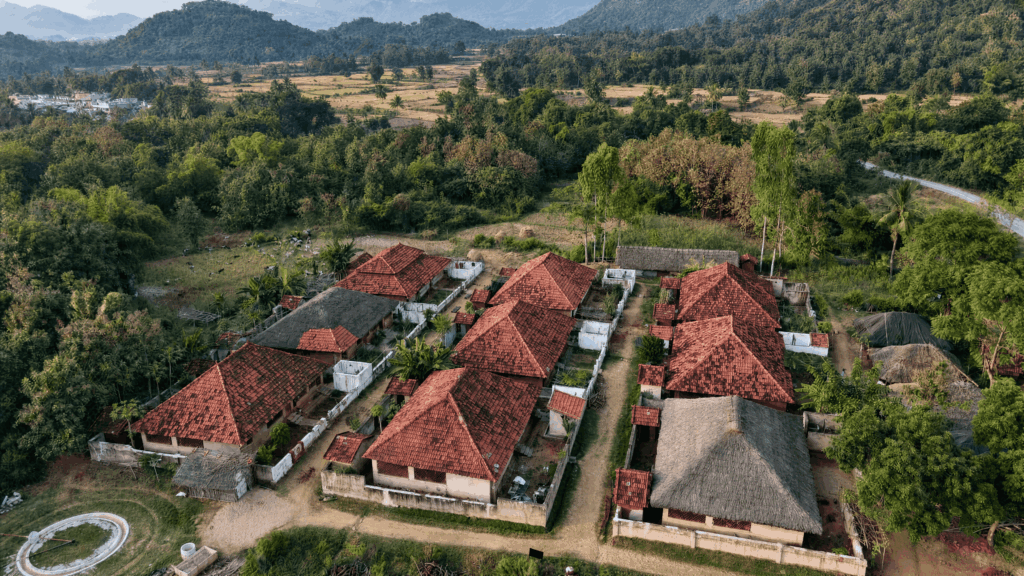
A farm community of around 80 residents across 60 acres in Srikakulam district, Andhra Pradesh, founded in 2018 under the Nanda Gokulam Goshala Trust.
It is not a village in the ordinary sense. Nobody inherited a house here.
It began in 2018 as a farm community under the Nanda Gokulam Goshala Trust. Sixty acres. Alongside the homes there is a goshala, a cow shelter, and a gurukulam, a traditional school.
The community describes itself in four words. Simple. Natural. Traditional. Dharmic.
The address alone tells you something about the scale of the place. Near Anthakapalli Village, Kittalapadu Post, Via Shrimukhalingam, Srikakulam District, Andhra Pradesh, 532428.
You go via somewhere else to get there.
The name comes from the neighbourhood. Srikurmam, a few districts over, holds one of the very few temples in India where Vishnu is worshipped as Kurma, the tortoise. Kurmagram means the village of Kurma.
And the houses were designed after the Sri Mukhalingam temple, a ninth-century structure nearby.
So a village built in 2018 was drawn from a building put up eleven hundred years earlier.
Principles of Kurmagram Vedic Village Community’s
The community follows the teachings of A.C. Bhaktivedanta Swami Prabhupada, founder of ISKCON. A recorded exchange of his appears on their homepage as the founding principle.

If you visit their website, the first thing on it is not a welcome message. It is a fragment of a conversation.
Prabhupada is speaking to a disciple named Hamsaduta.
He says that with no luxuries, living a very simple life, you save time for chanting Hare Krishna. Hamsaduta agrees. And Prabhupada answers that this is his desire, and that one should not waste time on bodily comforts.
That exchange sits at the top of the page, before anything else.
The community states plainly that it is based on the instructions of His Divine Grace A.C. Bhaktivedanta Swami Prabhupada, the founder of the International Society for Krishna Consciousness.
Which matters for understanding the place. This is not a general back-to-the-land experiment or an eco-village with a spiritual flavour. It is a devotional community, and everything else follows from that.
The absence of electricity is not primarily an environmental position. It is a way of removing distraction.
Kurmagram Houses Have No Cement
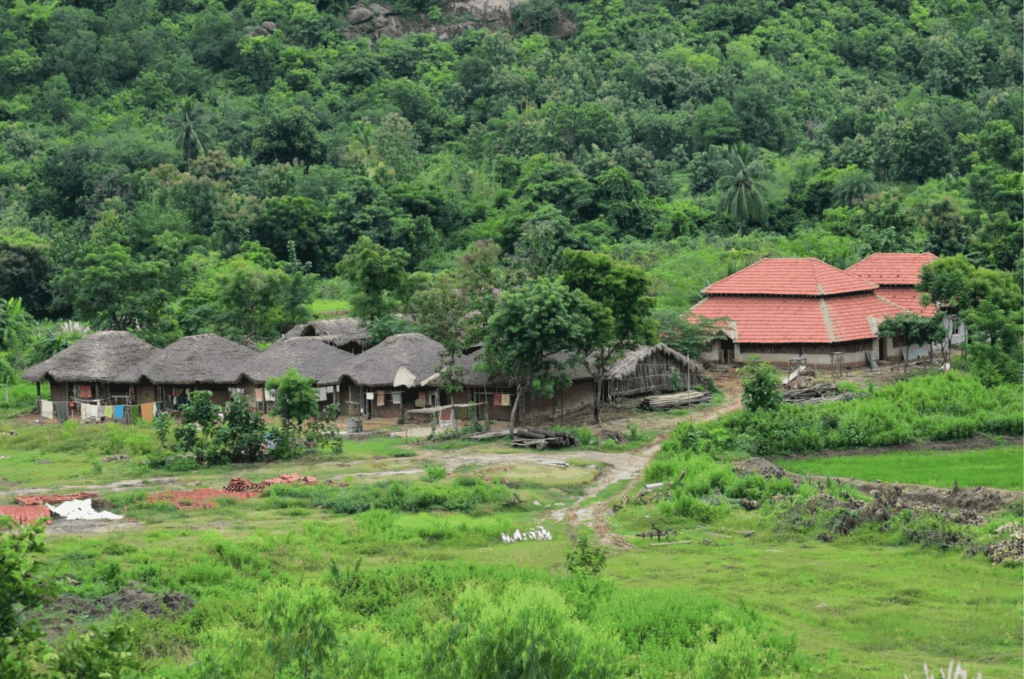
Homes are built from mud, stone, brick, wood and limestone. No cement and no iron are used anywhere.
This is the detail that makes builders stop and ask questions.
The community lists its materials openly. Mud, stones, bricks, wood, limestone. And then, plainly, no cement or iron.
Not less cement. None.
That rules out reinforced concrete, steel beams, the standard vocabulary of every Indian building put up in the last seventy years. The houses were largely built by the residents themselves, using traditional methods, drawing on the ninth-century temple down the road.
Everything else in daily life follows the same logic.
Lighting is oil lamps. When the sun goes down the village goes dark, and by half past seven everyone is asleep.
Cooking is done on firewood or cow-dung cakes. No gas stoves and no cylinders anywhere in the settlement.
Water comes from wells rather than borewells. The reasoning given is that a borewell drills into Bhumi, the earth, more violently than a well does. Whether or not you find that persuasive as hydrology, it is a consistent position.
Soap is replaced with natural materials. Vegetables and grains are grown on the land.
What a Day Looks Like at Kurmagram Vedic Village
Rise at 3:30 am for Mangal Arati, work and study through the day, communal meals cooked on wood fire, asleep by 7:30 pm.
Sixteen hours awake, and the shape of them barely changes.
Half past three is Brahma Muhurta, the hour and a half before dawn that Hindu tradition regards as the most favourable time of day for spiritual practice.
The residents rise then for Mangal Arati, the first worship of the day.

Meals are cooked collectively in a shared kitchen, on wood fire, using what the land produces.
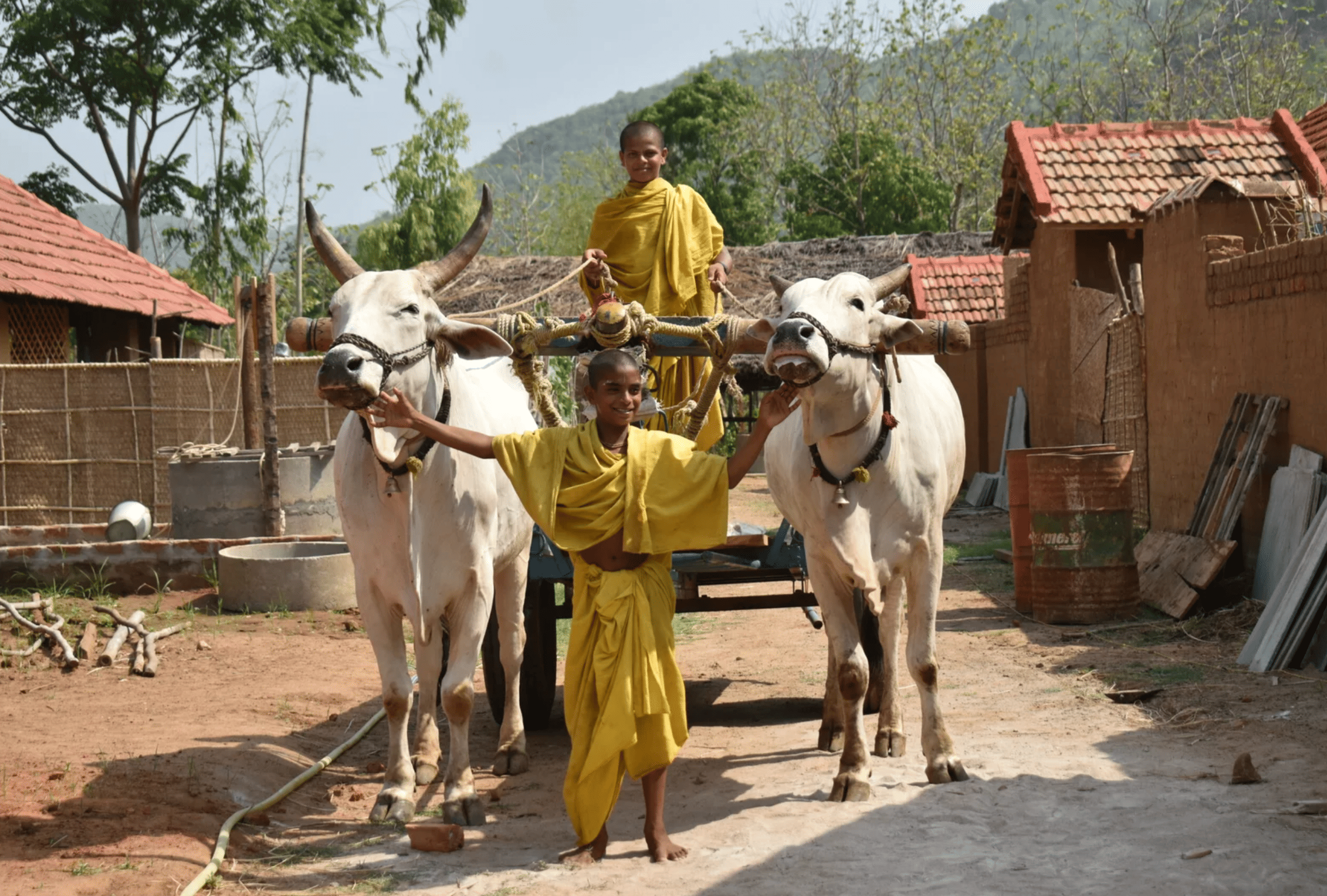
Everyone does seva, unpaid work for the community. Somebody has to look after the cows, tend the fields, cook, teach, build. There is no staff.
And by half past seven at night, with no light to work by, the village is asleep.
The rhythm is the point. Without electric light the day is bounded by the sun, which is how nearly every human being lived until about a hundred and fifty years ago.
Nobody in Kurmagram has to decide when to stop scrolling.
Their is a Gurukulam School
A gurukulam where children study Sanskrit, English and mathematics, with the stated aim of identifying each child’s natural aptitude rather than preparing them for a career.

The village runs its own school.
Children learn Sanskrit, English and mathematics, so this is not an education that leaves them unable to function outside. English is on the syllabus deliberately.
What the community says distinguishes it is the aim.
Rather than preparing a child for a predetermined career track, the teaching is meant to identify what a particular child is naturally inclined toward, and build from there.
The stated goal is a life of purpose and satisfaction rather than a particular income.
The obvious question, and it is a fair one. A child educated here, in a village with no internet, will at some point encounter a world that runs entirely on it.
Whether they are equipped for that, or whether they will want to be, is not something anyone can answer for another decade.
The community would presumably say that is exactly the wrong measure.
About The People Who Joined
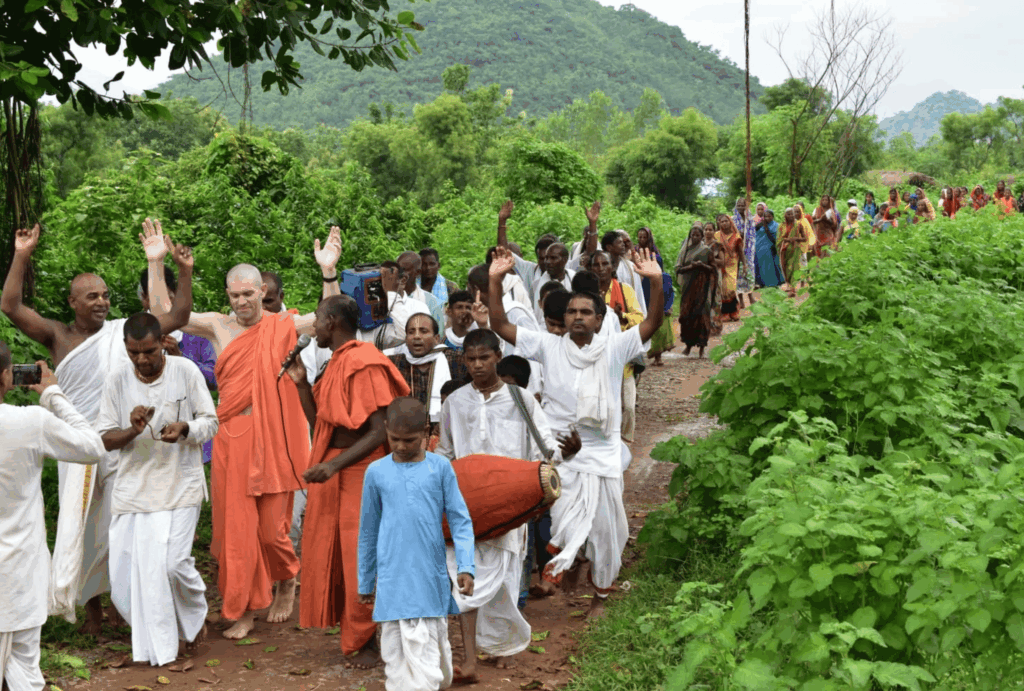
The residents came from ordinary Indian life, including at least one who left a career in information technology.
This is what separates Kurmagram from a story about a remote village that time forgot.
Nobody here forgot anything. They all knew exactly what they were leaving.
Radhakrishna Charan Das left the information technology sector to come here. He describes his life now as the one his ancestors lived three centuries ago.
The community comprises fourteen families along with unmarried devotees. Reports note that despite having the means to access modern facilities, the residents have voluntarily given up material comforts.
Having the means is the operative phrase.
These are not people without options. They had salaries, smartphones, air conditioning, hospitals within reach. They walked away from all of it, and they can walk back at any time.
Nobody is trapped in Kurmagram. That is what makes it interesting.
What They Say They Are Rejecting
Not technology in itself, but what they see as its cost. Industrialisation producing anxiety, environmental damage and distraction from spiritual life.
The residents put their philosophy in four words that Prabhupada used constantly. Simple living, high thinking.
The argument they make is that modern industrial life produces anxiety and damages the environment, and that a life arranged around less of it produces inner peace and a closer relationship with the natural world.
You do not have to agree with that to notice they are being consistent about it. There is no wifi in the office because there is no office.
There is no compromise version where the adults keep phones and only the children go without.
Where a reasonable person might push back.
Kurmagram exists inside modern India. When someone falls seriously ill, there is a hospital eleven hundred kilometres of road network away, built with cement and iron and running on electricity.
The trust that owns the land holds title under a legal system, and the website telling you all this is hosted on a server somewhere.
None of that makes the choice dishonest. It makes it a choice rather than an escape, which is a different and more interesting thing.
What the Numbers Actually Say?
Sources disagree on population and on how old the tradition is. The village itself is unambiguously seven years old.
Worth being straight about, because the numbers circulating vary a lot.
Population. The community’s own website says about 80 residents. A news report says 56, across fourteen families. Both could be true at different moments in a place people join and leave.
Age of the tradition. This is where it gets strange. One social media post describes Kurmagram as following 200-year-old traditions.
A news report says the lifestyle dates back nearly 300 years, to the eighteenth century. The documentary that brought the village to wider attention describes 5,000-year-old Vedic traditions.
Two hundred, three hundred, five thousand.
The village was founded in 2018. That much is stated on their own About page and is not in dispute.
None of those figures is a lie. They are describing different things. The Vedic texts are ancient. The specific lifestyle of pre-industrial rural India is a couple of centuries back. The settlement is seven years old.
The confusion happens when a headline collapses all three.
And it matters for how you read the place. A village that has always lived this way would be a story about isolation.
A village founded in 2018 by people who had smartphones is a story about deliberate refusal.
The second one is far more unusual.
How to Visit?
Near Anthakapalli Village, Kittalapadu Post, via Shrimukhalingam, Srikakulam District, Andhra Pradesh 532428. Roughly 110 kilometres from Visakhapatnam.
Visitors are received, and they are fed.
Meals offered to guests are served as prasadam, food first offered in worship. That is not a restaurant transaction and it is worth understanding before you arrive.
Practical realities. No electricity means no charging point for your phone, which you will have brought and will not be able to use anyway. No internet.
Lighting after dark is oil lamps. The village sleeps at half past seven.
Contact them before you go. This is a residential community of eighty people, not a tourist site with opening hours. Their website carries an address and contact details.
And go with the right frame. People here are living a life, not performing one. Videos of Kurmagram have drawn hundreds of thousands of views, and the residents did not ask for that.
If you want to understand the devotional tradition the community belongs to, read our piece on what the research shows about the Hare Krishna mantra and our guide to Hindu meditation techniques.
Summary Table
| Question | Answer |
|---|---|
| Where | Srikakulam district, Andhra Pradesh, ~110 km from Visakhapatnam |
| Founded | 2018, under Nanda Gokulam Goshala Trust |
| Size | 60 acres |
| Population | About 80 per the community, 56 across 14 families per news reports |
| Tradition followed | Teachings of A.C. Bhaktivedanta Swami Prabhupada, ISKCON founder |
| Electricity | None. Oil lamps. |
| Cooking | Firewood and cow-dung cakes. No gas. |
| Building materials | Mud, stone, brick, wood, limestone. No cement, no iron. |
| Water | Wells rather than borewells |
| Phones and internet | None |
| Day begins | 3:30 am, Brahma Muhurta, Mangal Arati |
| Day ends | Asleep by 7:30 pm |
| Education | Gurukulam teaching Sanskrit, English, mathematics |
| Also on site | Goshala and Vedic gurukulam |
| Architecture drawn from | Sri Mukhalingam temple, 9th century |
| Guests | Received and served prasadam |
Key Takeaways for Readers
Where is Kurmagram vedic village?
Near Anthakapalli Village, Kittalapadu Post, via Shrimukhalingam, in Srikakulam district, Andhra Pradesh, PIN 532428. It sits roughly 110 kilometres from Visakhapatnam and covers about 60 acres.
How many people live in Kurmagram?
The community’s own website says about 80 residents. A news report gives 56 people across 14 families along with unmarried devotees. Numbers in a community people join and leave will vary.
Can you visit Kurmagram?
Yes. Visitors are received and served meals as prasadam. It is a residential community of around eighty people rather than a tourist attraction, so contacting them in advance is appropriate. Expect no electricity, no charging points and no internet, and note that the village sleeps at 7:30 pm.
Is Kurmagram connected to ISKCON?
The community states it is based on the instructions of A.C. Bhaktivedanta Swami Prabhupada, who founded the International Society for Krishna Consciousness. It operates under the Nanda Gokulam Goshala Trust and maintains a goshala and a Vedic gurukulam.