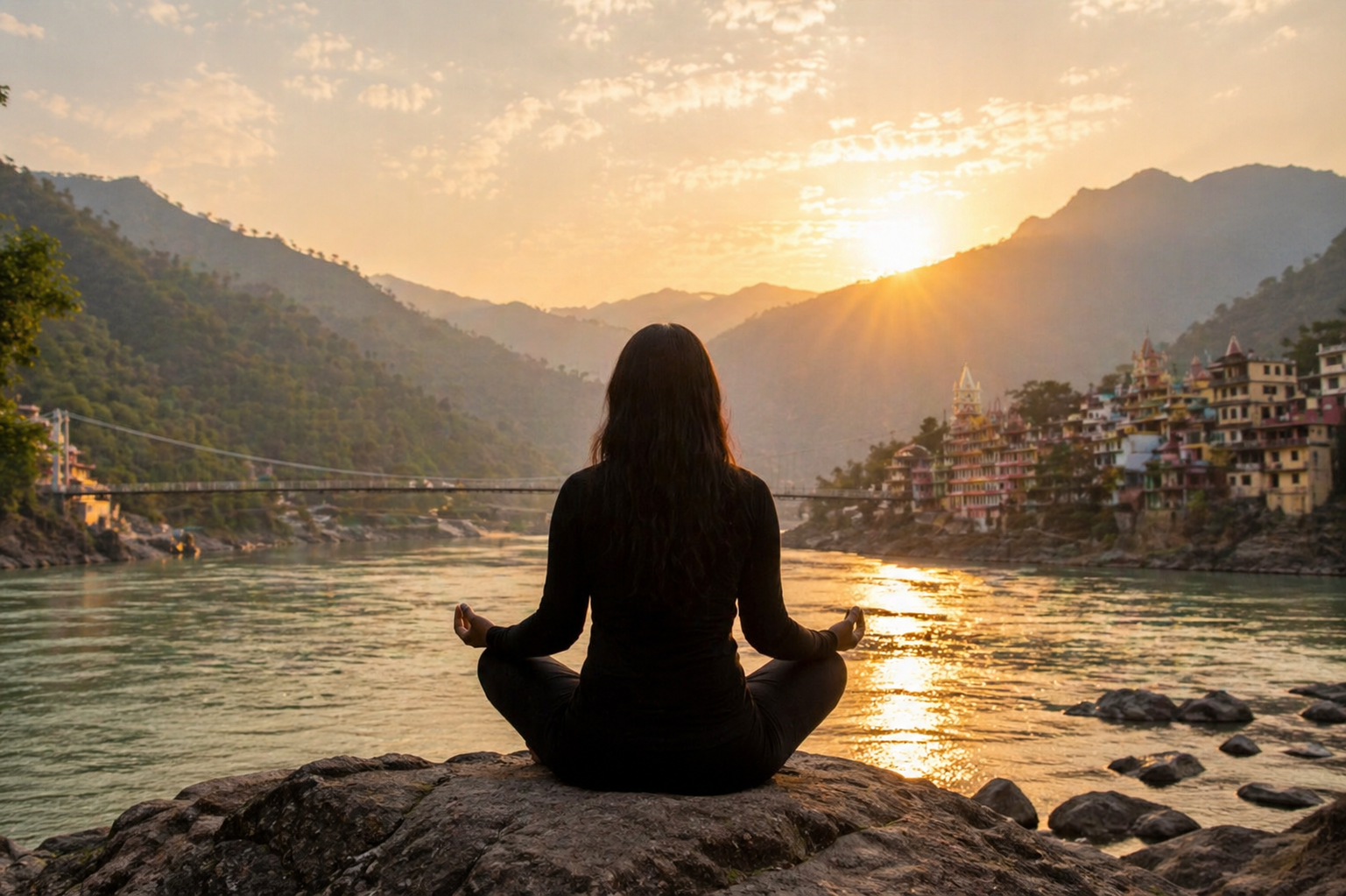
How to Start Daily Meditation
You can start daily meditation by sitting still for a few minutes, paying attention to your breath, and repeating this consistently. That’s the whole method. Research shows that even short daily sessions 10 minutes or less can reduce stress and improve focus within a few weeks.
According to Harvard Health Publishing, regular meditation is associated with reduced stress, improved focus, and better emotional regulation. The difficulty is not the technique. It’s staying consistent. Once you understand why each step works, the practice becomes easier to stick with.
How to Start Daily Meditation: The Honest Truth
Most people overcomplicate how to start daily meditation. They think they need the right posture, the perfect time, or a special cushion. You don’t.
Here’s the real answer:
Sit down. Pay attention to your breath. Come back when your mind wanders. That’s enough.
You can sit on a chair. On your bed. On the floor. It doesn’t matter as much as people think. What matters is that you show up and do it again tomorrow.
If you prefer a more structured approach, programs like Inner Engineering by Sadhguru build this habit step-by-step through guided practice.
What exactly do I do when I sit down?
When learning how to start daily meditation, most beginners ask: “What am I supposed to do?” You notice your breathing. That’s it. But not perfectly.
You’ll follow your breath for a few seconds. Then your mind drifts. You think about something random. Or something important. Then you notice it and come back. That “coming back” part? That’s the practice. Not silence. Not stillness. Just returning attention.
Most beginner guides explain this but don’t emphasize it enough. The benefit comes from repetition of that cycle.
Why does focusing on the breath actually work?
Because your breath is directly connected to your nervous system. The U.S. National Center for Complementary and Integrative Health (NCCIH) notes that meditation can affect how the body responds to stress by influencing breathing patterns and nervous system activity.
You don’t have to force anything. When you pay attention to breathing:
- It slows slightly.
- Your body follows.
- Your mind settles a bit.
You’re not “trying to relax.” You’re creating the conditions where relaxation happens.
A 2022 study in Nature Scientific Reports showed that breath-focused meditation reduces activity in the brain’s default mode network, which is linked to overthinking and distraction. That’s why breath is used in almost every beginner method. If you want to go deeper into breathing techniques, you can explore pranayama practices, which train breath more actively.
Why does my mind keep wandering?
This is the #1 frustration when people learn how to start daily meditation. Because that’s what your mind is designed to do. It’s not a problem. It’s the starting point. Normally, your attention is scattered across:
- Your phone
- Conversations
- Tasks
When you sit still, all of that becomes visible. So it feels like “I’m worse at this than I thought.” But actually noticing distraction and returning attention is the exact mechanism that improves focus. Neuroscience studies show this process strengthens the prefrontal cortex, which controls attention and decision-making.
How long should I meditate each day?
Start shorter than you think. It works better. You don’t need 20 minutes right away.
Try this schedule:
Week 1: 5 minutes daily
Week 3: 10 minutes daily
Week 5: 15 minutes daily
That’s enough. A study in Frontiers in Psychology (2022) found measurable improvements in stress and sleep after about 4 weeks of short daily sessions. The key pattern across studies is simple daily practice and moderate duration. Not long sessions.
The American Psychological Association (APA) reports that mindfulness meditation can reduce stress and improve emotional regulation in both clinical and non-clinical populations.
When is the best time to meditate?
The best time is the one you can repeat consistently. Morning works well because that time offers fewer distractions and a clearer mind. Evening works because it helps you slow down. But none of that matters if you don’t stick to it.
Pick a time that fits your routine . Do not focus on an ideal one.
Why does meditation feel uncomfortable at first?
Because you’re removing distraction, not because you’re doing it wrong. When you stop external input, you start noticing internal activity. That includes restlessness, thoughts, and impatience. It can feel like something is off. But this is actually awareness increasing.
Most people quit here. Not because meditation fails, but because they expect calm too early.
That’s why understanding how to start daily meditation honestly, including the discomfort, helps you push through.
How do I make meditation a daily habit?
Attach it to something you already do. Instead of relying on motivation connect it to a routine.
For example:
- After brushing your teeth
- Before coffee
- Before sleep
This works because habits form more easily when tied to existing behaviors. You remove the need to decide every day.
What if I miss a day?
You continue the next day. Nothing resets. This is where most people drop the habit. They think:
“I missed one day, so I failed.” But meditation doesn’t work like that. Progress is cumulative. Not fragile. Even long-term practitioners miss days. What matters is returning.
How do I know if meditation is working?
You don’t notice it during meditation. You notice it outside of it. It shows up as small changes:
- You react a little less quickly
- You pause before responding
- You don’t follow every thought
A 2022 review in Frontiers in Psychology links meditation to improved emotional regulation and reduced stress responses. It’s subtle. But consistent. Moreover, the Mayo Clinic states that meditation can help reduce negative emotions, improve self-awareness, and increase patience in daily situations.
Why is consistency more important than duration?
Because repetition rewires patterns. Duration alone doesn’t. Meditation works like training. Each session reinforces attention. Each return builds control.
Over time, you will notice:
- Baseline stress decreases
- Focus improves
- Emotional reactions stabilize
A 2024 study in Frontiers in Human Neuroscience found long-term changes in brain connectivity with sustained meditation practice. That only happens with consistency. Harvard research also suggests that consistent daily practice even for short durations can lead to measurable improvements in mental well-being over time.
Are there any risks or things to be careful about?
Meditation is generally safe, but not always comfortable.
According to NCCIH, some people may experience:
- Temporary anxiety
- Emotional discomfort
- Restlessness
This is usually mild and temporary. If symptoms are intense or persistent, it’s better to adjust the practice or consult a professional.
What’s the simplest way to start today?
If you’re still wondering how to start daily meditation, here’s your answer:
Sit down for 5 minutes and follow your breath. Then repeat tomorrow. That’s enough. You don’t need perfect focus, posture or perfect conditions
You just need repetition.
What do major health institutions say about daily meditation?
Leading medical and psychological institutions agree that meditation supports mental and physical health when practiced consistently.
According to:
- Harvard Health: improves focus and emotional well-being.
- Mayo Clinic: reduces stress and negative thinking.
- APA: improves emotional regulation and attention.
- NCCIH: affects stress response and physiological balance.
What this means:
Meditation is not just a traditional practice. It is widely studied and supported across modern health institutions.
Summary Table
| Step | Why It Works |
|---|---|
| Sit still | Reduces external distraction |
| Focus on breath | Stabilizes attention |
| Notice thoughts | Builds awareness |
| Return attention | Trains focus |
| Repeat daily | Builds long-term change |
Key References
Frontiers in Psychology. Meditation and stress outcomes. 2022
https://www.frontiersin.org/journals/psychology/articles/10.3389/fpsyg.2022.814224/full
Nature Scientific Reports. Brain network changes. 2022
https://www.nature.com/articles/s41598-022-17325-6
Frontiers in Psychology. Mindfulness and stress review. 2022
https://www.frontiersin.org/journals/psychology/articles/10.3389/fpsyg.2022.854204/full
PubMed Central. Meditation brain research
https://pmc.ncbi.nlm.nih.gov/articles/PMC9232427/
Frontiers in Human Neuroscience. Long-term effects. 2024
https://www.frontiersin.org/journals/human-neuroscience/articles/10.3389/fnhum.2024.1482353/full
NCCIH. Meditation in depth
https://www.nccih.nih.gov/health/meditation-in-depth
Harvard Health Publishing. Mindfulness meditation improves mental health
https://www.health.harvard.edu/mind-and-mood/mindfulness-meditation-improves-mental-health
Mayo Clinic. Meditation: A simple, fast way to reduce stress
https://www.mayoclinic.org/tests-procedures/meditation/in-depth/meditation/art-20045858
American Psychological Association. Meditation and mindfulness
https://www.apa.org/topics/mindfulness/meditation



9 Comments