How to Start Chakra Meditation
Something is shifting in how young Indians approach their inner lives. They are not looking for rigid rituals or complex philosophies. They are looking for something practical, grounded, and honest. Something that meets them exactly where they are, which is usually exhausted, overstimulated, and quietly searching.
Chakra meditation is one of the practices they are finding. Not because it is trending on Instagram, but because it works. It gives a distracted mind a specific place to go, a structured path from scattered to settled, from anxious to grounded. And it asks nothing of you except your attention.
This is The Inner Path’s complete beginner’s guide to chakra meditation for anyone who is curious but does not know where to start.
What Is Chakra Meditation and Why Is It Trending in 2026
Chakra meditation is a structured practice that systematically directs attention through the body’s seven primary energy centers using breath, visualization, and sound to cultivate emotional balance, nervous system regulation, and inner clarity.
The Global Wellness Summit identified nervous system regulation as wellness’s next frontier in its 2026 Future of Wellness report, noting that modern digital life keeps nervous systems in a constant state of fight or flight and that the next wave of wellness moves beyond performance toward emotional repair and embodied care. Practices that offer regulation over results and sensation over scores are gaining significant ground.
Market Xcel confirms this in its India-specific wellness trends analysis, noting that neurowellness, a concept built on nervous system regulation and stress physiology, is gaining traction among urban professionals experiencing high burnout. Crucially, India holds a structural advantage in this space: yoga, pranayama, and chakra-based meditation are cultural assets that neurowellness is now validating through science rather than replacing with technology. For a generation exhausted by optimization culture and always-on digital life, chakra meditation offers something rare. A practice built on inner listening, not measurement.
Why Young Indians Are Turning to Chakra Meditation Specifically
Young urban Indians are turning to chakra meditation because it provides a structured framework for emotional regulation that fits naturally within India’s existing cultural heritage, making it feel authentic rather than imported.
Market Xcel confirms that India holds a structural advantage in the global neurowellness movement because yoga, pranayama, and chakra-based practices are cultural assets that science is now validating rather than replacing. For a young Indian professional in Mumbai or Bengaluru experiencing burnout, chakra meditation does not feel like a foreign wellness trend. It feels like returning to something that was always there.
The Global Wellness Summit describes the broader shift driving this: powerful new desires for no-tech, deeply human, social, and emotional wellness are raging against the high-tech, hyper-optimizing approaches that have dominated wellness for the past decade. The next phase of wellness moves toward emotional repair, nervous system safety, and embodied care. Chakra meditation delivers all three through a practice that costs nothing, requires no device, and can be done in a bedroom or on a rooftop at sunrise.
This is why chakra meditation studios are appearing as the latest addition to holistic healing options in metro cities across India. And why young people, exhausted by the pressure to constantly stay on, are finding that the most radical thing they can do is sit quietly and listen inward.
What Are the Seven Chakras and What Do They Represent
The seven chakras are energy centers located along the spine from the base to the crown of the head, each governing a distinct dimension of physical, emotional, and spiritual wellbeing according to ancient yogic tradition.
Isha Foundation describes the seven fundamental chakras with precision: Muladhara at the perineum (foundation, security), Swadhisthana just above the genital organ (creativity, pleasure), Manipuraka just below the navel (willpower, action), Anahata beneath the rib cage (love, compassion), Vishuddhi at the pit of the throat (expression, power), Ajna between the eyebrows (intuition, clarity), and Sahasrara at the crown of the head (cosmic consciousness, enlightenment). Each chakra has both a physical and a spiritual dimension. As Sadhguru explains, comparing lower and higher chakras is like comparing the foundation of a building to the roof. Neither is superior. Both are essential.
Insight Timer describes the specific colors, sounds, and yoga postures associated with each chakra. The root chakra Muladhara is linked to the color red and the sound LAM, associated with feelings of groundedness and physical security. The heart chakra Anahata is linked to green and the sound YAM, associated with love and emotional connection. The crown chakra Sahasrara carries the color violet and the sound of silence, associated with spiritual awareness and connection to something larger than the self.
What Are the Signs of a Blocked Chakra and How Do You Know Which One Needs Attention
Blocked chakras typically show up as persistent emotional patterns, physical tension in specific body areas, or recurring life challenges connected to the qualities that chakra governs, such as feeling chronically unsafe for a blocked root chakra or struggling to speak honestly for a blocked throat chakra.
According to Mindvalley, every chakra has unique symptoms, both physical and mental, that indicate deficient or excessive energy. When you understand the purpose and challenge of each center, you can identify imbalances and direct your practice accordingly. Chakra expert Anodea Judith describes chakras as portals between the inner and outer worlds, meaning whatever you do inside transforms the outside.
Whole Living identifies the most common signs of imbalance per chakra for beginners:
| Chakra | Location | Signs of Imbalance | Affirmation to Use |
|---|---|---|---|
| Root (Muladhara) | Base of spine | Chronic anxiety, financial stress, feeling unsafe, disconnected from body | I am safe. I am grounded. I belong here. |
| Sacral (Swadhisthana) | Below navel | Emotional numbness, creative blocks, difficulty with pleasure or intimacy | I feel. I create. My emotions are valid. |
| Solar Plexus (Manipura) | Above navel | Low confidence, people pleasing, difficulty making decisions | I am powerful. I trust myself. I act with courage. |
| Heart (Anahata) | Center of chest | Difficulty giving or receiving love, grief, isolation, bitterness | I love and I am loved. My heart is open. |
| Throat (Vishuddha) | Throat | Difficulty speaking up, fear of judgment, chronic throat tension | I speak my truth. My voice matters. |
| Third Eye (Ajna) | Between eyebrows | Brain fog, indecision, disconnection from intuition | I trust my inner knowing. I see clearly. |
| Crown (Sahasrara) | Top of head | Feeling purposeless, spiritually disconnected, cynical about meaning | I am connected to something greater. I am guided. |
For beginners, the most practical approach is to work the whole system from root to crown in every session rather than trying to diagnose a specific blocked chakra. Over time, you will naturally notice which centers feel more resistant or tense, and you can spend extra time there.

What Are the Benefits of Chakra Meditation for Mental Health
Chakra meditation and related mindfulness practices have been shown to reduce cortisol levels, decrease anxiety and perceived stress, improve emotional regulation, and support physical markers of wellbeing including telomere length.
Healthline cites a 2023 study with 100 young adults that found heartfulness meditation, a yogic tradition closely related to chakra-based practices, significantly reduced cortisol levels, anxiety, and perceived stress. Researchers also noted that this type of meditation affected telomere length, DNA proteins that help protect chromosomes and cells, suggesting the benefits may extend beyond mood to cellular health over time.
A 2025 systematic review published in the Journal of Science Technology Engineering Arts and Mathematics analyzed 19 high-quality studies and found that chakra meditation produces significant improvements in autonomic balance and respiratory performance. The review noted that chakra meditation facilitates secretion of melatonin from the pineal gland, which may function as a psycho-sensitive hormone supporting both sleep and emotional regulation. The researchers concluded that chakra meditation shows real promise as a tool for mental performance and holistic health, particularly when administered consistently over time.
For those who want to complement chakra meditation with a breathwork practice, our guide to the 11 minute miracle breathwork explains how conscious breathing directly activates the vagus nerve and the parasympathetic nervous system.
What Do You Need to Start Chakra Meditation
You need nothing except a quiet space, a comfortable seated position, and ten minutes. No special equipment, no prior experience, and no spiritual background are required to begin.
Positivity.org emphasizes this point directly: while chakra meditation is rooted in ancient traditions, modern science does not confirm the existence of chakras as physical energy systems. Many practitioners report increased mindfulness, reduced stress, and a greater sense of inner alignment through regular practice. The visualization and body awareness components of chakra meditation align with techniques shown to enhance interoception, the body’s ability to sense its own internal states. You do not need to believe in energy centers to benefit from the practice of paying deliberate, compassionate attention to your body.
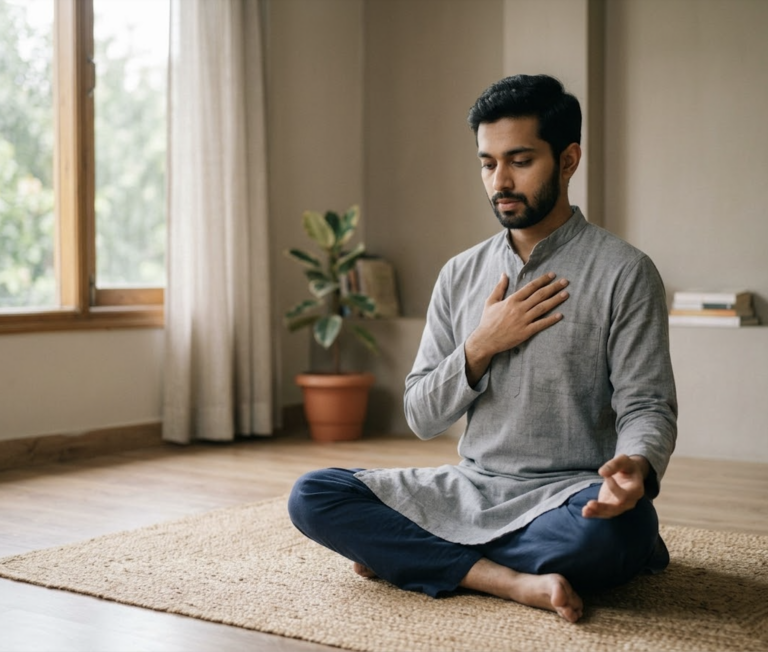
Life is Positive suggests creating a calm environment by dimming the lights, putting your phone on silent, and optionally using incense, essential oils, or soft ambient music. Sit on the floor with your spine relatively straight, on a chair if that is more comfortable, or even on a cushion. The point is not the posture. The point is the quality of your attention. Start small. Even 10 minutes a day makes a noticeable difference. You do not need 45 minutes to begin feeling the benefits.
How to Practice Chakra Meditation
Start at the root chakra at the base of your spine and move upward through each of the seven chakras, spending one to two minutes on each, using breath, color visualization, and seed mantras to bring awareness and energy to each center.
Liforme outlines the practice with clarity for beginners. Sit comfortably with your spine long. Begin with a few minutes of deep, slow breathing to settle the body. Then bring your attention to the base of your spine and visualize a red wheel of energy spinning there. Chant the syllable LAM on each exhale for one to two minutes. Move your hands to your belly below the navel for the sacral chakra, visualizing orange and chanting VAM. Continue upward: solar plexus (yellow, RAM), heart (green, YAM), throat (blue, HAM), third eye (indigo, OM), and finally crown (violet, breathe in silence). At each chakra, imagine energy flowing freely as you breathe. At the crown, simply rest in stillness.
BetterSleep adds a useful closing step: once you have moved through all seven, imagine all your chakras spinning clockwise simultaneously, aligned and energized. Then slowly open your eyes and give yourself a moment before returning to the day. The entire practice can be done in 20 to 30 minutes. A guided recording can be helpful at the beginning, but the structure is simple enough to internalize within a few sessions.
For those new to sitting meditation, our guide on how to start daily meditation covers posture, timing, and building consistency before adding a chakra focus.
What Common Mistakes Do Beginners Make in Chakra Meditation
The most common beginner mistakes are forcing the practice, expecting dramatic results immediately, skipping the grounding root chakra, and trying to do too much too soon, all of which create frustration rather than calm.
Art of Living explicitly warns that if you apply force to chakra meditation, you can potentially unbalance your system. This is why it is better to practice under proper guidance or instructions, particularly at the beginning. The chakras are part of an intimately connected network, meaning that if one is out of balance, it affects all the rest. Forcing energy in one area without attending to the others can create more discomfort than relief.
Positivity.org offers practical guidance for the most common obstacles beginners face:
If you feel drowsy, try sitting upright in a chair or opening your eyes slightly rather than fighting it. If your mind wanders, gently return to the chakra you were focusing on with no judgment. If visualizing colors feels strange or too abstract, shift your focus to physical sensation instead, noticing warmth, pressure, or tingling in the area of each chakra. These sensations are enough. If emotions surface unexpectedly, breathe into the space without reacting. Let the emotion move through you. This is the practice working, not a sign that something has gone wrong.
The most important thing a beginner can do is start small and stay consistent. Three minutes of genuine attention is more valuable than thirty minutes of frustrated effort.
How Often Should You Practice Chakra Meditation
Beginners should start with two sessions per week of 10 to 15 minutes each, gradually increasing to three to five sessions per week as the practice becomes familiar, with daily practice being the long-term ideal.
MyYogaTeacher provides specific guidance for new practitioners: start twice a week and increase gradually based on comfort and the guidance of a coach or teacher if available. Even 10 to 15 minutes per session can produce noticeable benefits in emotional balance, reduced stress, and mental clarity over time. Most practitioners begin noticing shifts after a few weeks of consistent practice rather than after a single session.
Cymbiotika notes that while daily practice is ideal, each person’s journey is unique. If daily meditation feels overwhelming, several sessions per week is enough. The key is listening to your body and emotions rather than forcing a schedule. During periods of particular stress, a life transition, or emotional uncertainty, you may find it helpful to increase the frequency temporarily. During calmer periods, even two or three sessions per week will maintain the benefits you have built. Consistency over time matters far more than duration per session.
For a deeper exploration of how private daily practice is reshaping how young Indians relate to spirituality, read our piece on private solo spirituality in India.
Getting Started with Chakra Meditation at a Glance
| Question | Answer |
|---|---|
| What is chakra meditation | A structured practice directing attention through seven energy centers using breath, visualization, and sound |
| What are the seven chakras | Root, Sacral, Solar Plexus, Heart, Throat, Third Eye, Crown — each governing different emotional and physical dimensions |
| What are the main benefits | Reduced cortisol, lower anxiety, improved emotional regulation, better sleep, greater inner clarity |
| What do I need to start | A quiet space, 10 minutes, and a comfortable seated position. No equipment required. |
| How do I practice | Start at the root chakra, move upward through each center using breath, color, and seed mantras |
| How often should I practice | Beginners: twice a week, 10 to 15 minutes. Long term ideal: daily practice |
| When will I notice results | Most practitioners notice shifts after a few weeks of consistent practice |
Key Takeaways for Readers
- The Global Wellness Summit identified nervous system regulation as wellness’s next frontier in 2026, and chakra meditation is one of the most accessible practices for achieving this. (Source: Global Wellness Summit)
- A 2023 study with 100 young adults found that heartfulness meditation significantly reduced cortisol levels, anxiety, and perceived stress, and may even affect telomere length. (Source: Healthline)
- A 2025 systematic review of 19 high-quality studies found chakra meditation improves autonomic balance, respiratory performance, and facilitates melatonin secretion from the pineal gland. (Source: Journal STEAM)
- You need no equipment, no prior experience, and no spiritual background to begin. A quiet space and 10 minutes is enough for your first session.
- Begin at the root chakra and move upward through all seven, spending one to two minutes on each, using breath, color visualization, and seed mantras.
- Beginners should start with two sessions per week and build gradually. Consistency matters far more than duration. (Source: MyYogaTeacher)
References
- Global Wellness Summit. (2026, January 27). Global Wellness Summit Releases 10 Wellness Trends for 2026. https://globalwellnessinstitute.org/press-room/press-releases/global-wellness-summit-releases-10-wellness-trends-for-2026/
- Market Xcel. (2026, April 9). Top 12 Wellness Trends in India 2026: Consumer Insights. https://www.market-xcel.com/blogs/wellness-trends-india
- Isha Foundation. (2023, August 10). 7 Chakras: Mystical Dimensions of the Body’s Seven Chakras. https://isha.sadhguru.org/en/wisdom/article/7-chakras-mystical-dimensions-body-seven-chakras
- Insight Timer Blog. (2019, September 25). The 7 Chakras Explained in the Yogic Tradition. https://insighttimer.com/blog/the-7-chakras-of-the-yoga-tradition/
- Healthline. (2024, September 26). Chakras and Anxiety: Is There a Link? https://www.healthline.com/health/mind-body/anxiety-chakra
- Journal of Science Technology Engineering Arts and Mathematics. (2025). Meditation and Energy Chakra Balance: A Systematic Review. https://journal-steam.com/wp-content/uploads/2025/06/Meditation-and-Energy-Chakra-Balance.pdf
- Positivity.org. (2026, April 17). Healing Chakra Meditation: Complete Beginner’s Guide. https://positivity.org/meditation/healing-chakra-meditation-guide
- Life is Positive. (2026). Chakra Meditation for Beginners: 6 Easy Steps That Work. https://lifeispositive.com/chakra-meditation-beginners/
- Liforme. (2025, June 11). How Do I Start Chakra Meditation? https://liforme.com/blogs/blog/how-do-i-start-chakra-meditation
- BetterSleep. (2024, May 31). A Quick Guide to Chakra Meditation. https://www.bettersleep.com/blog/a-quick-guide-to-chakra-meditation
- Cymbiotika. (2025, March 25). How Often Should You Do Chakra Meditation for Optimal Balance? https://cymbiotika.com/blogs/health-hub/how-often-should-you-do-chakra-meditation-for-optimal-balance
- MyYogaTeacher. (2025, September 9). 5 Chakra Meditation Techniques to Balance Your Energy Centers. https://myyogateacher.com/articles/chakra-meditation-techniques
- Mindvalley. (2025, April 8). Chakra Meditation for Beginners: Benefits and Examples. https://blog.mindvalley.com/chakra-meditation/
FAQs on Chakra Meditation
What is chakra meditation for beginners?
Chakra meditation is a structured practice that directs attention through the body’s seven energy centers from root to crown using breath, color visualization, and seed mantras. It requires no prior experience, no equipment, and no spiritual background. A quiet space and 10 minutes is enough to begin.
What are the seven chakras in order?
The seven chakras from base to crown are: Muladhara (root, base of spine), Swadhisthana (sacral, below navel), Manipura (solar plexus, above navel), Anahata (heart, center of chest), Vishuddha (throat), Ajna (third eye, between eyebrows), and Sahasrara (crown, top of head).
Does chakra meditation actually have scientific benefits?
Yes. A 2023 study with 100 young adults found heartfulness meditation significantly reduced cortisol, anxiety, and perceived stress. A 2025 systematic review of 19 studies found chakra meditation improves autonomic balance and respiratory performance and facilitates melatonin secretion from the pineal gland.
How long should a beginner’s chakra meditation session be?
Beginners should start with 10 to 15 minutes per session, spending one to two minutes on each chakra. Over time, sessions can extend to 20 to 40 minutes as the practice becomes more familiar.
How often should you do chakra meditation?
Beginners should start with two sessions per week and gradually increase to three to five sessions per week. Daily practice is the long-term ideal. Consistency over time produces more noticeable results than occasional long sessions.