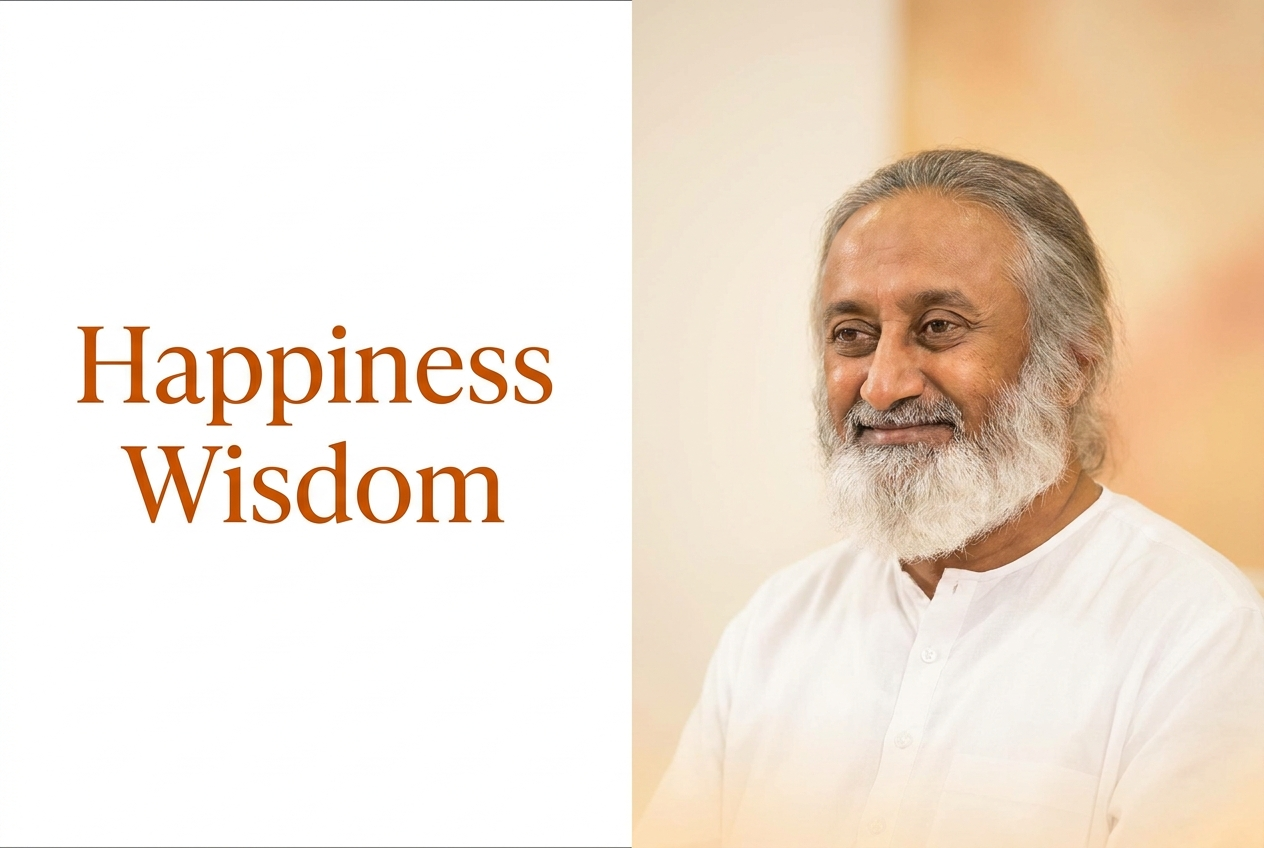
Sri Sri Ravi Shankar’s Happiness Mantra
Sri Sri Ravi Shankar teaches that happiness is not something we chase, but something we uncover. According to his philosophy, stress, overthinking, and constant desires cover our natural state of calmness. When these disturbances reduce, happiness becomes visible again. Practices like breathing techniques, meditation, and service help remove these layers. Scientific research supports this view.
Studies from Princeton show external success does not create lasting happiness, while Harvard research confirms that meditation improves emotional stability. This makes happiness a trainable internal condition.
What is happiness according to Sri Sri Ravi Shankar?
Happiness, according to Sri Sri Ravi Shankar, is a stable inner state that exists when the mind is calm and free from constant disturbance.
He separates happiness from pleasure. Pleasure depends on events. Happiness, in his framework, does not. It is closer to a quiet sense of ease that remains even when external conditions change. This idea is clearly reflected in classical Indian philosophy.
The Bhagavad Gita (2.66) explains that without inner stillness, there is no peace, and without peace, happiness cannot exist
Sri Sri’s explanation becomes practical when he connects this to mental activity. When the mind is constantly comparing, reacting, or worrying, happiness becomes unstable. When these movements reduce, even briefly, people experience relief that feels deeper than excitement.
This aligns with findings from the American Psychological Association, which highlight emotional regulation as a key factor in long-term well-being. Happiness, in this sense, is not created. It is revealed.
Where does Sri Sri say happiness comes from?
Sri Sri Ravi Shankar teaches that happiness comes from within and is not dependent on external achievements.
This directly challenges the common belief that happiness follows success. Most people assume that once certain goals are achieved, happiness will become permanent. Sri Sri points out that this rarely happens.
The reason is explained by modern research. A study from Princeton University found that beyond a certain level of financial security, increases in income do not significantly improve emotional well-being.
This happens because the mind adapts quickly. What once felt exciting becomes normal. Then a new desire appears.
Sri Sri describes this pattern clearly:
→ Desire creates restlessness
→ Fulfillment gives temporary relief
→ New desire restarts the cycle
Breaking this cycle requires shifting attention inward. When the mind stops constantly projecting into the future, it begins to settle. In that settled state, happiness becomes available without needing a trigger.
How can I start if I feel unhappy most of the time?
Start with the breath and body, not with thoughts.
Sri Sri emphasizes that the mind follows the breath. If the breath is rapid and irregular, the mind becomes unstable. When the breath slows down, the mind naturally begins to settle.
A practical starting method is simple. Sit comfortably. Keep your spine upright. Inhale slowly for a few seconds. Then exhale slightly longer than the inhale. Continue this for 10 minutes.
This is not just a spiritual idea. It is physiological. Research highlighted in Psychology Today explains that slow breathing techniques reduce stress and improve emotional control by activating the parasympathetic nervous system.
If you want to understand this deeper, read What is Pranayama?
Sri Sri’s advanced practices, such as Sudarshan Kriya, build on the same principle. But even basic breath awareness creates noticeable changes when practiced consistently.
What are the biggest obstacles to happiness according to Sri Sri?
The biggest obstacles to happiness are internal mental patterns, not external situations. Sri Sri identifies several patterns that disturb the mind:
→ Constant comparison
→ Attachment to outcomes
→ Resistance to present reality
→ Overthinking
These patterns create a state where the mind is rarely at rest. Even positive situations become unstable because the mind keeps shifting.
A well-known study published in Science (2010) supports this idea. It found that people are less happy when their minds wander toward past or future thoughts:
Sri Sri’s approach is not to eliminate thoughts, but to change the relationship with them. Through breath awareness and meditation, thoughts are observed without immediate reaction. This creates space. In that space, emotional stability develops.
How does Sri Sri connect happiness with service to others?
Sri Sri Ravi Shankar connects happiness with service because service shifts attention away from constant self-focus.
When the mind is focused only on personal concerns, it tends to amplify problems. Even small issues feel significant. Service interrupts this pattern by expanding one’s perspective.
Research from the Greater Good Science Center at UC Berkeley shows that helping others increases life satisfaction and reduces stress.
This happens because service creates a sense of connection. It reduces isolation and brings a different kind of fulfillment that is not dependent on achievement.
Sri Sri refers to this as expanding identity. When identity expands, emotional pressure reduces. As a result, happiness becomes more stable.
Can happiness be sustained, or does it always come and go?
Happiness can become more stable, but only with consistent practice.
Without any inner work, happiness tends to fluctuate. External events constantly influence mood. This makes happiness feel unpredictable.
However, when practices like meditation and breath control are used regularly, the baseline begins to change. Emotional reactions become less intense. Recovery from stress becomes faster.
A study from Harvard Medical School found that meditation can change brain regions associated with stress and emotional regulation. You can explore this deeper here:
15 Scientifically Proven Benefits of Meditation.
Sri Sri’s teaching aligns with this. He does not promise constant excitement. He points toward stability.
What is the simplest daily practice Sri Sri recommends for happiness?
The simplest practice is a combination of breathing and meditation.
Start with a short routine. Spend a few minutes slowing down your breath. Then sit quietly and observe your thoughts without trying to control them.
Harvard Health explains that breath control activates the relaxation response, which reduces stress signals in the body. This connects closely with structured programs like:
Inner Engineering by Sadhguru.
The key is consistency. Even a short daily practice creates gradual change.
What Most Articles Miss About Sri Sri’s Teachings
What most articles miss about Sri Sri Ravi Shankar’s teachings on happiness is the mechanism behind the transformation.
They often say “happiness comes from within,” but do not explain how. The actual process works like this:
Breath regulates the nervous system. The nervous system affects emotional reactions.
Emotional reactions shape how life is experienced.
Sri Sri’s system works because it addresses all three levels. It is not just philosophical. It is practical.
Summary Table
| Area | Explanation | Why It Matters |
|---|---|---|
| Happiness Definition | Natural inner state | Reduces dependence on outcomes |
| Source | Internal awareness | Stops constant chasing |
| Core Method | Breath + meditation + service | Regulates mind and body |
| Obstacles | Desire, comparison, overthinking | Causes instability |
| Scientific Support | Brain and emotional regulation studies | Validates practice |
| Long-Term Outcome | Stable emotional baseline | More consistent well-being |
FAQs on Sri Sri Ravi Shankar’ Happiness Teachings
What is Sri Sri Ravi Shankar’s main teaching on happiness?
Happiness is a natural inner state that becomes visible when stress and mental disturbances reduce.
Can external success create lasting happiness?
No. Research shows external success provides only temporary satisfaction.
What is the fastest way to feel better?
Slow breathing helps calm the nervous system and reduces emotional intensity.
Does helping others improve happiness?
Yes. Studies show service increases life satisfaction and reduces stress.
Can happiness become stable?
Yes, with consistent practices like meditation and breathwork.
Key References
Bhagavad Gita 2.66
https://www.holy-bhagavad-gita.org/chapter/2/verse/66
Princeton University Study
https://www.pnas.org/doi/10.1073/pnas.1011492107
Harvard Medical School
https://news.harvard.edu/gazette/story/2011/01/eight-weeks-to-a-better-brain/
American Psychological Association
https://www.apa.org/monitor/2012/07-08/ce-corner
Science Journal
https://www.science.org/doi/10.1126/science.1192439
UC Berkeley
https://greatergood.berkeley.edu/article/item/how_helping_others_benefits_you
Harvard Health
https://www.health.harvard.edu/mind-and-mood/relaxation-techniques-breath-control-helps-quell-errant-stress-response





2 Comments