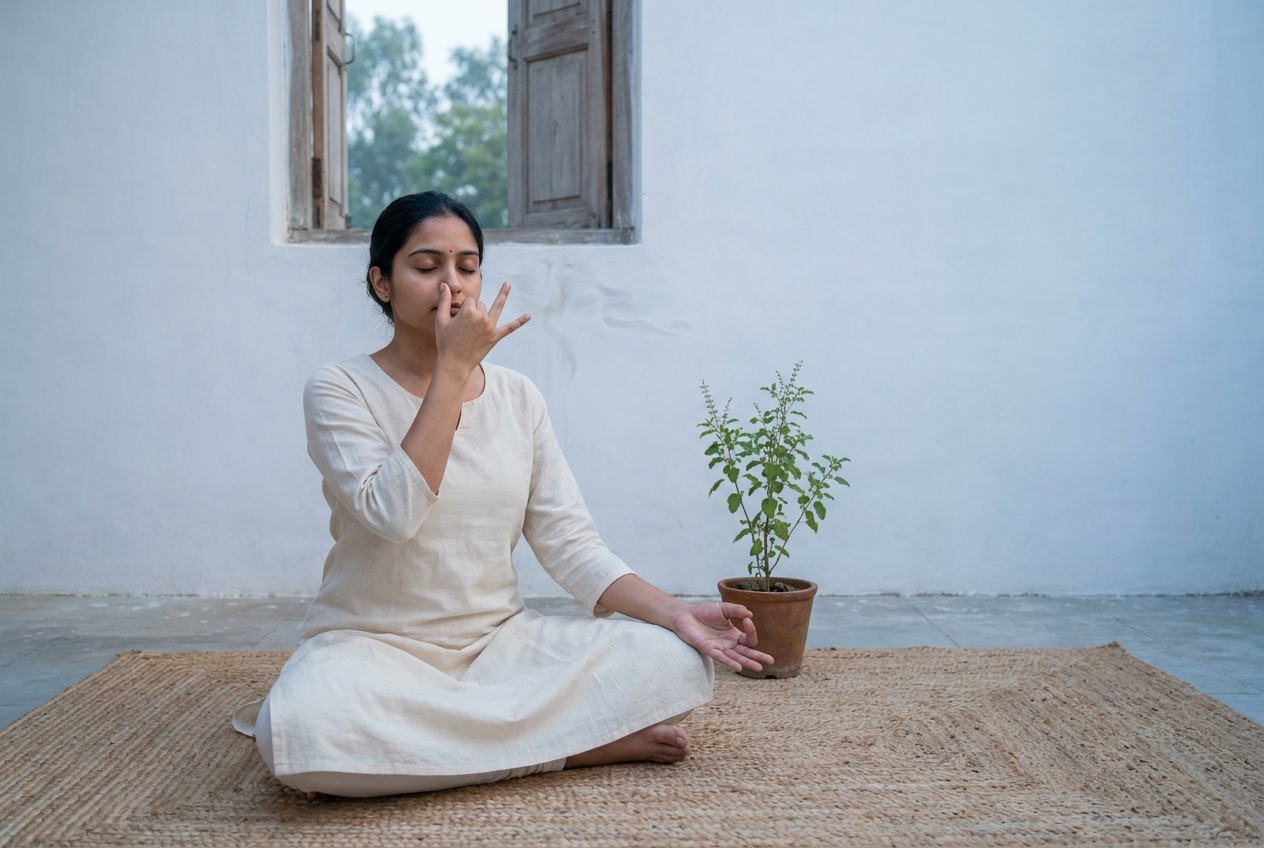
What is Pranayama? Learn Yogic Breathing
Pranayama is the practice of controlling your breath to influence your physical and mental state. It comes from classical yoga, but modern research shows that slow, controlled breathing can reduce stress, improve focus, and regulate the nervous system.
You don’t need to believe in any philosophy to try it. At its simplest, pranayama is just paying attention to how you breathe and gradually learning to guide it.
What does Pranayama actually mean?
Pranayama means expanding or regulating the breath, but in practice, it’s about learning how breathing affects your body and mind.
The word comes from Sanskrit:
- prana = life force or breath
- ayama = expansion or control
In traditional texts like the Yoga Sutras of Patanjali (2.49), pranayama is introduced after physical postures. It’s meant to prepare you for meditation. But if you step away from the terminology, what matters is simpler:
You change your breathing → your body responds → your mind follows. That’s the core idea.
Why is breathing such a big deal in yoga?
Because breathing is one of the few body functions you can control directly and it affects everything else. Most of the time, you don’t notice your breath. It runs in the background.
But it’s connected to your:
- Heart rate
- Stress response
- Level of alertness
When you’re anxious, your breathing changes. When you’re calm, it changes again. Pranayama flips that relationship. Instead of emotions changing your breath, you use your breath to influence your state.
The U.S. National Center for Complementary and Integrative Health explains that breathing-based practices can affect how the body responds to stress.
How does Pranayama actually affect my brain and body?
Pranayama works by altering breathing patterns, which directly influence brain activity, heart rate, and stress response.
Here is what happens inside the body:
→ Slow breathing increases oxygen efficiency
→ It reduces activity in the Default Mode Network (DMN), which is linked to overthinking
→ It improves heart rate variability (HRV)
→ It lowers cortisol levels
According to a 2020 study in Frontiers in Human Neuroscience. Controlled breathing can:
- Improve attention
- Reduce anxiety
- Enhance emotional control
Harvard Medical School also notes that slow breathing triggers the relaxation response. This explains why pranayama is often used before meditation.
How does Pranayama work in the body?
It works by shifting your nervous system out of “stress mode” and into “recovery mode.”You don’t feel this instantly in a dramatic way. It’s more subtle.
When you slow your breathing:
- The heart rate tends to slow.
- Your muscles release tension.
- The body moves toward a calmer baseline.
This is linked to the parasympathetic nervous system, which handles rest and recovery.
A Harvard Health overview on breath control notes that slow breathing can help quiet the stress res. You don’t need to think about the biology while practicing—but it helps to know there’s a reason it works.
Is Pranayama the same as meditation?
No. Pranayama works on the breath. Meditation works on attention. They’re connected, but they’re not the same thing.
Here’s a simple way to look at it:
| Practice | What you do | What it trains |
|---|---|---|
| Pranayama | Control or observe breath | Body + nervous system |
| Meditation | Observe thoughts or focus attention | Mind + awareness |
In most traditions, pranayama comes first. Because if your body is restless, sitting quietly becomes harder. If you’re building a routine, this fits naturally with How to Start Daily Meditation, where breath awareness is often the first step.
What are the main types of Pranayama?
There isn’t just one method. Different techniques are used for different effects. You don’t need all of them. But it helps to understand what exists.
Nadi Shodhana (alternate nostril breathing)
You switch between nostrils while breathing.
This is often used to balance attention and calm the mind.
Bhramari (humming breath)
You exhale with a soft humming sound.
This tends to reduce mental agitation.
Kapalbhati (forceful exhale)
Quick, active breathing.
More energizing, but not ideal for beginners.
Simple slow breathing (most practical)
Inhale slowly → exhale slowly.
This is what most research is based on.
A review in Frontiers in Human Neuroscience found that controlled breathing practices can influence brain activity and emotional regulation.
What are the scientifically proven benefits of Pranayama?
Pranayama can reduce stress, improve heart function, and support emotional regulation. This is where a lot of confusion happens. People either overstate the benefits or dismiss them.
The reality sits in the middle.
Research suggests:
- Slower breathing improves heart rate variability (a marker of stress resilience)
- Controlled breathing can reduce perceived stress
- Regular practice may support focus and emotional control
A clinical review available through PubMed Central links breathing practices to improved cardiovascular and respiratory efficiency. Also, the Mayo Clinic also notes that relaxation practices, including breath control, can help reduce stress and improve overall well-being.
This doesn’t mean pranayama replaces treatment. But it can support how your body handles stress.
How should I start Pranayama?
Start with slow, simple breathing. Don’t overcomplicate it. You don’t need advanced methods.
Try this:
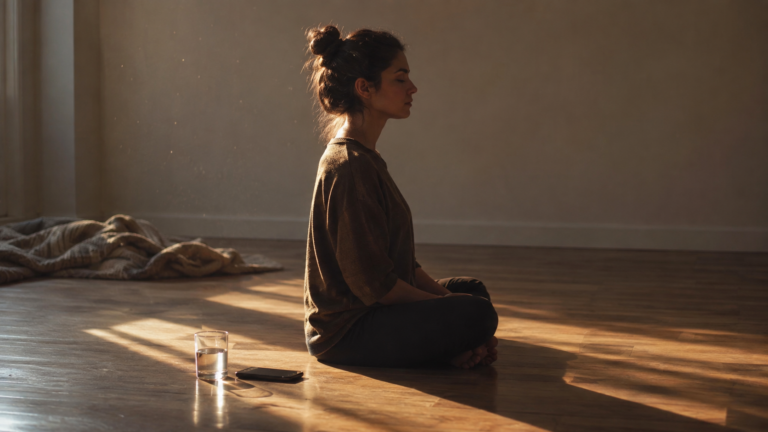
→ Sit comfortably
→ Inhale slowly for 4 seconds
→ Exhale for 6 seconds
→ Repeat for 5–10 minutes
That’s enough.The goal is not control.
It’s awareness and rhythm.
When should I practice Pranayama?
Morning is ideal, but consistency matters more than timing.
Best times:
→ early morning (empty stomach)
→ before meditation
→ during stress
Avoid:
Immediately after heavy meals
Are there any risks with Pranayama?
Yes, some techniques should be done carefully. Most slow breathing practices are safe. But forceful breathing (like Kapalbhati) and long breath retention may not suit everyone.
According to NCCIH, some individuals may experience discomfort if techniques are done incorrectly.
Start simple. Progress gradually.
How does Pranayama connect to daily meditation?
Pranayama prepares the mind for meditation by calming the body first.
If your body is restless, meditation feels harder
Breathing helps:
→ stabilize attention
→ reduce mental noise
That’s why many structured systems combine both. Programs like Inner Engineering use breath-based practices before meditation.
Summary Table
| Topic | Key Takeaway |
| Definition | Breath regulation practice |
| Purpose | Influence body and mind |
| Best for | Stress, focus, preparation for meditation |
| Beginner method | Slow inhale–exhale breathing |
| Risk level | Low if done gently |
FAQ About Pranayama
What is Pranayama in simple terms?
It is the practice of controlling your breath to influence your physical and mental state.
Is Pranayama scientifically proven?
Research shows it can affect stress response, heart rate, and emotional regulation.
Can beginners do Pranayama?
Yes. Simple slow breathing is suitable for beginners.
Is Pranayama better than meditation?
They serve different purposes. Pranayama prepares the body. Meditation trains the mind.
Key References
Hatha Yoga Pradipika, Chapter 2
https://www.sacred-texts.com/hin/hyp/hyp03.htm
Patanjali. Yoga Sutras (2.49–2.52)
https://www.sacred-texts.com/hin/yogasutr.htm
Frontiers in Human Neuroscience. (2020). Breathing practices and neural mechanisms.
https://www.frontiersin.org/articles/10.3389/fnhum.2020.00075/full
Harvard Medical School. Relaxation response and breath control.
https://www.health.harvard.edu/mind-and-mood/relaxation-techniques-breath-control-helps-quell-errant-stress-response
Stanford Medicine. (2022). Breathing patterns and mood.
https://med.stanford.edu/news/all-news/2022/01/breathing-patterns-affect-mood.html
BMC Complementary Medicine. (2017). Alternate nostril breathing study.
https://bmccomplementmedtherapies.biomedcentral.com/articles/10.1186/s12906-017-1865-1
Frontiers in Psychiatry. (2018). Meditation and anxiety meta-analysis.
https://www.frontiersin.org/articles/10.3389/fpsyt.2018.00353/full
Journal of Ayurveda and Integrative Medicine. (2017). Yoga and physiological risks.
https://www.ncbi.nlm.nih.gov/pmc/articles/PMC5418997/
Journal of Neurophysiology. (2017). Breathing and brain rhythms.
https://journals.physiology.org/doi/full/10.1152/jn.00828.2016


2 Comments